

How should you look after a dental implant in the first 14 days?
Good dental implant aftercare in the first 14 days protects the blood clot and the healing gum with cold packs, soft food, gentle rinses and no smoking. Swelling usually peaks at 48 to 72 hours and settles within about a week, and stitches usually dissolve by day 10 to 14. Pain or swelling that gets worse after day 3, a fever or a loose implant are reasons to call your surgeon, and our dental implants guide explains the full treatment.
- Swelling peaks
- 48–72 hours
- Feel normal again
- Usually 5–7 days
- Stitches
- Dissolve by day 10–14
- Call if
- Worse after day 3, or fever
- Flying home
- Most fly after 24–48 h
- Bone healing
- 3–6 months to final crown
Key takeaways
- Swelling that peaks at 48 to 72 hours and some bruising are normal. Pain or swelling that gets worse after day 3 is not.
- Protect the clot for 24 hours: no rinsing, spitting, straws, hot drinks or smoking.
- Eat soft food for the first week, then soft food chewed on the other side. Keep anything hard off the implant until the final crown.
- Most of our patients fly home 24 to 48 hours after surgery. It depends on the case, so your surgeon confirms the timing for you.
What is normal after dental implant surgery?
Some bleeding, swelling, bruising and soreness are normal for the first few days after an implant is placed, and most people feel close to normal within a week.
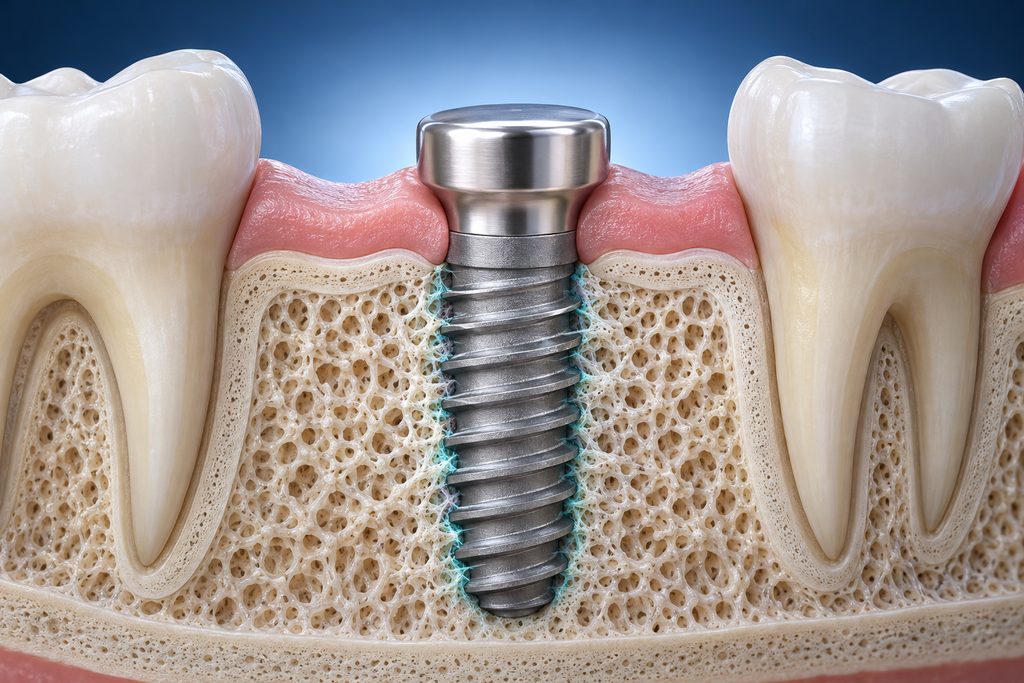
Osseointegration is the process in which the jawbone grows directly onto the surface of an implant until the two are firmly joined. It usually takes 3 to 6 months, and about 4 months is typical.3 The first 14 days protect the start of that process: a stable blood clot, a closed gum and no pressure on the implant.
One implant in healed bone is often easier than a wisdom tooth removal; several implants, a bone graft or a sinus lift mean a slower first week. Our dental implants treatment guide explains the two trips, and this post covers the recovery. Your own surgeon’s written instructions always come first.
- 48–72 hswelling peaksthen settles over about a week
- 24 hno rinsing or spittingto protect the blood clot
- 10–14 daysstitchesdissolve on their own
- 3–6 monthsbone healingbefore the final crown
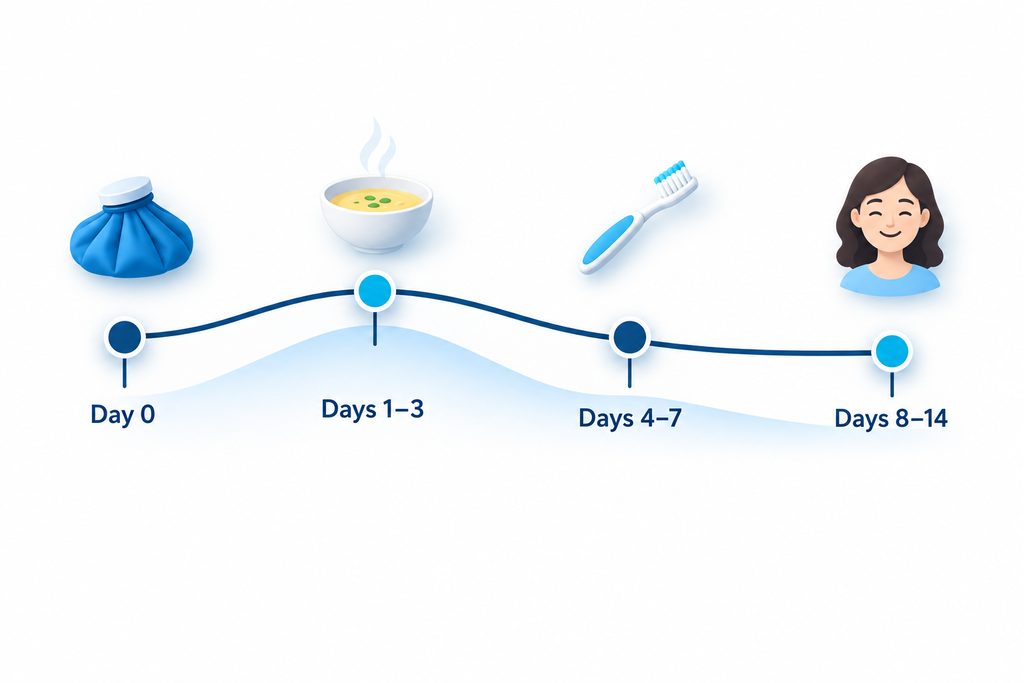
Dental implant recovery day by day, from day 0 to day 14
A typical recovery after one to three implants in healthy bone. Grafts and sinus lifts follow the same pattern, more slowly.
- Day 0
Surgery day: bite, rest, keep cool
Bite on the gauze for 30 to 45 minutes; pink saliva is expected. Rest with your head raised, use a cold pack, and eat cool, soft food once the numbness has gone. No rinsing, spitting, hot drinks, straws or smoking.
- Day 1
Swelling starts, first gentle rinse
Swelling builds. Short cold-pack sessions still help, and painkillers work better taken on time, as prescribed. From 24 hours, start warm saltwater rinses after meals unless told otherwise.
- Days 2–3
The peak
Swelling and stiffness usually peak now, and bruising may appear. This is expected, not a sign of infection. Many travelling patients fly home around now: most of ours fly 24 to 48 hours after surgery, after a final check.
- Days 4–7
Swelling goes down
Swelling fades and pain eases a little each day. Stay on soft food, chewed on the other side, and keep exercise to gentle walks.
- Days 8–10
Stitches start to dissolve
Dissolving stitches loosen and usually fall away by day 10 to 14. Stitches that need removing come out at a short appointment, which can be with your dentist at home.
- Days 11–14
Almost back to normal
Bruising has usually gone. Keep hard food off the implant and have your two-week check, by video or in person. Pain that is getting worse now is not normal.
How long does swelling last after a dental implant?
Swelling usually peaks at 48 to 72 hours and then settles over 5 to 7 days. Any bruising tends to show on day 2 or 3 and fades within about 10 days.
Cold first, then time
Hold a cold pack wrapped in a cloth against the cheek for 10 to 15 minutes in each hour of the first day.1 Never put ice directly on the skin. After the first 24 to 48 hours, cold does little.
Pain relief, as your dentist prescribes
Most people manage with ordinary painkillers such as paracetamol or ibuprofen, taken only as your dentist prescribes or approves. Regular doses for the first 2 to 3 days work better than waiting for the pain to build.1
Ibuprofen does not suit everyone, for example with stomach ulcers or blood thinners, so list every medicine you take.
Antibiotics only if prescribed
Not every implant patient needs a course of antibiotics. A Cochrane review found that a single preventive dose before surgery reduced early implant failures, while it is less clear that longer courses afterwards add anything.5 If you are given a course, finish it exactly as directed.
What can you eat after dental implant surgery?
After dental implant surgery, eat cool, soft food for the first 24 hours and soft food that needs little chewing for the rest of the first week. In the second week, move to fork-tender food (soft enough to cut with a fork), chewed on the other side. The aim is to keep heat, crumbs and pressure away from the implant.
Wait until the numbness has worn off, and choose lukewarm over hot for 2 days, because heat can restart bleeding.
Eat little and often, and drink plenty of water. Protein helps healing, so yoghurt, eggs, soft fish and hummus are good staples. In Istanbul, lentil soup (mercimek çorbası) is on almost every menu, and our Istanbul dental trip itinerary has more soft-food ideas.

Which foods are safe after an implant, and when?
For one or a few implants. Follow your surgeon’s plan if it differs.
| Days 0–1 | Days 2–7 | Days 8–14 | |
|---|---|---|---|
| Texture | Cool liquids and very soft food | Soft, little chewing | Fork-tender, chewed on the other side |
| Good choices | Yoghurt, smoothies eaten with a spoon, cool soup, plain ice cream | Scrambled eggs, mashed potato, porridge, hummus, lentil soup, soft fish | Pasta, rice, cooked vegetables, minced meat, soft bread without the crust |
| Avoid | Hot drinks, alcohol, straws, anything crunchy | Seeds, nuts, crisps, spicy or acidic food | Hard, sticky or crunchy food on the implant side |
| Temperature | Cool or room temperature | Lukewarm | Normal, if comfortable |
Until the final crown is fitted 3 to 6 months later, keep hard food off the implant site, even when it feels fine.
How do you clean your mouth after an implant?
After implant surgery, keep the rest of your mouth clean from the first evening, but leave the implant site alone for 24 hours while the blood clot settles.
- Day 0: brush your other teeth gently with a soft brush and let the water fall out of your mouth rather than spitting.
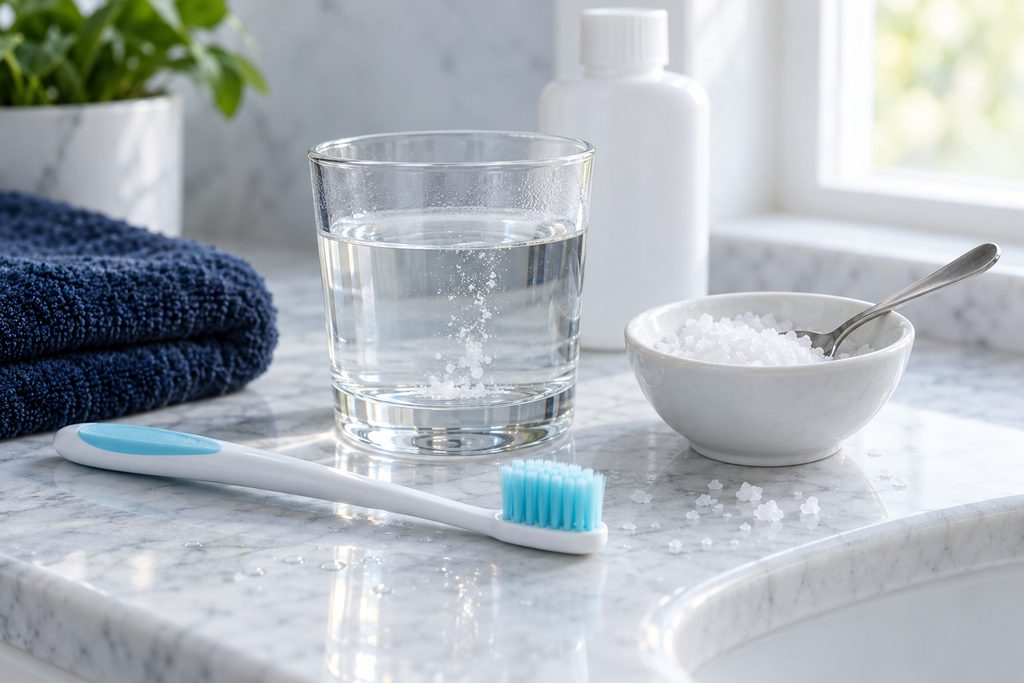
- From day 1 or 2: rinse gently with warm salty water after meals and before bed, unless your surgeon says otherwise.2 About half a teaspoon of salt in a glass of warm water is enough.
- Chlorhexidine: this antiseptic mouthwash is often prescribed after implant surgery; at Dentsway it is used for 10 days.1 It can stain teeth brown for a while, and toothpaste weakens it, so leave about 30 minutes between brushing and rinsing.
- The implant site: let the mouthwash clean it for the first 7 to 10 days.1 Then brush gently around the healing cap (the small metal cap that shapes the gum) with an ultra-soft brush. Keep electric brushes and water flossers away from it until your surgeon says otherwise.
Do not poke the stitches with your tongue or pull your cheek back to inspect them: it stretches the wound.
Can you smoke or drink alcohol after dental implants?
It is safest not to smoke or drink alcohol after dental implant surgery. Smoking is one of the clearest risk factors for implant failure, and alcohol slows healing and reacts with some medicines. If you smoke, stop for at least 2 weeks after surgery, ideally 8 weeks, or for good.
A systematic review and meta-analysis found that implants in smokers failed significantly more often than in non-smokers, with more post-operative infections and more bone loss around the implant.4 Tobacco reduces blood flow to the gum, and the suction of drawing on a cigarette can disturb the clot.
Vaping is not a safe swap: it still involves suction and, usually, nicotine. Nicotine patches, on a pharmacist’s advice, are gentler.
Avoid alcohol for at least 48 to 72 hours and while you take prescription painkillers. With metronidazole, an antibiotic sometimes used after dental surgery, drink no alcohol during the course and for 48 hours after it.
How should you sleep, and when can you exercise again?
Sleep with your head raised on an extra pillow for the first 2 or 3 nights, on the side opposite the implant if you can. Keeping your head above your heart reduces throbbing and morning swelling.
Gentle walking is fine from the day after surgery. Avoid running, the gym, swimming, heavy lifting and bending down for 3 to 5 days, because a higher blood pressure can restart bleeding. Build back up over the second week, and leave contact sports until your surgeon agrees.
Most problems after implant surgery start in the first week, and most are avoidable. Think of a cigarette on day two, a crusty sandwich on the implant side, or a call made too late.
When can you fly home after dental implants?
When you can fly depends on the case: most of our patients fly home 24 to 48 hours after implant surgery, once the surgeon has checked the site. Your surgeon confirms the timing for your case before you book the return flight.
A sinus lift or a large upper-jaw graft needs extra thought, because pressure changes can affect the healing sinus. After a sinus lift, do not blow your nose hard for 2 weeks, and ask your surgeon how soon you can fly. Get that advice in writing before you book.
Keep painkillers and prescriptions in your hand luggage, and bring soft snacks for the flight. Our dental trip packing list covers what else to carry.
Implant aftercare supplies: what to have ready
Buy it before surgery day, so you are not hunting for a pharmacy with a swollen cheek.
When should you call your dentist after implant surgery?
Call your surgeon if pain, swelling or bleeding is getting worse instead of better after day 3, if you have a temperature, or if anything feels loose.
The direction of change matters more than any single symptom: a problem usually shows as swelling or pain that returns after easing.
If you are home, contact the clinic that placed the implant first, with photos and your temperature. We offer video check-ups and can share your X-rays, scans and implant passport with your own dentist, who can help in the meantime; in the UK, NHS 111 can direct you to urgent dental care.

Normal healing or a warning sign: how can you tell?
If a symptom sits in the right-hand column, contact your surgeon the same day.
| Usually normal | Call your surgeon | |
|---|---|---|
| Bleeding | Oozing and pink saliva for 24 to 48 hours | Bright red bleeding that does not slow after 30 minutes of firm pressure |
| Swelling | Peaks at 48 to 72 hours, then goes down | Still growing after day 3, or coming back |
| Pain | Sore for 2 to 3 days, then easing; painkillers help | Getting worse after day 3, or not controlled by painkillers |
| Temperature | A slightly warm cheek | Fever of 38 °C or higher, or feeling shivery |
| Taste | A faint metallic taste at first | A bad taste, bad smell or pus |
| Numbness | Wears off within a few hours | Lip, chin or tongue still numb the next day |
| Implant or cap | A small metal cap showing through the gum | A cap or implant that feels loose |
| Sinus (upper jaw) | Slight stuffiness after a sinus lift | Liquid passing from mouth to nose |
If in doubt, send a photo. A false alarm costs minutes; a late infection can cost the implant.
What happens between week 2 and the final crown?
After two weeks the gum has usually healed, but osseointegration continues for 3 to 6 months before the final crown or bridge is fitted.3
- Weeks 2 to 6: eat normally on the other side and keep hard food off the implant.
- Months 1 to 3: a video or local check-up confirms the gum is healthy. Report any rubbing from a temporary denture.
- Months 3 to 6: the second trip, of about 5 days, is for scans, the abutment (the connector between implant and crown) and the final crown.
Peri-implantitis is a plaque-related inflammation of the tissues around an implant that causes gradual loss of the supporting bone. Past gum disease, poor plaque control and missed maintenance visits are among its main risk indicators.6 Daily cleaning and regular check-ups help prevent it, and we recommend both.
Full-arch treatment has its own plan: see our All-on-4 treatment page and the All-on-4 vs All-on-6 comparison. Still comparing clinics? Our guide to what cheap implant quotes leave out explains why aftercare belongs in the price.
What should you do next?
Plan your recovery at the same time as your surgery: dates, supplies and an aftercare contact matter as much as the implant.
- Read how the treatment works. Our dental implants page explains both trips, the implant brands and the lifetime warranty.
- Get a written plan. Send a photo or X-ray for a free plan with a fixed price.
- Book a flexible return flight. Most patients fly 24 to 48 hours after surgery; ask your surgeon what applies to you.
- Prepare. Buy the supplies above, and if treatment abroad is new to you, read our honest guide to dental treatment in Turkey.
- Save the aftercare contact. Know who answers if you are worried at 10 pm on day 4.
Frequently asked questions
Most people feel back to normal within 5 to 7 days after a single implant, with swelling peaking at 48 to 72 hours. The gum heals in about 2 weeks, but the bone needs 3 to 6 months to fuse with the implant before the final crown is fitted.
Wait until the local anaesthetic has fully worn off, usually a few hours, so you do not bite your cheek or tongue. Then start with cool, soft food such as yoghurt, and leave hot food until the next day.
Not hot on the first day, because heat can restart bleeding. From day 2, lukewarm coffee is fine for most people; drink it without a straw and do not move it around the implant site.
The safest answer is not at all, because smoking clearly raises the risk of implant failure. If you cannot stop for good, do not smoke for at least 2 weeks after surgery, ideally 8 weeks, and ask a pharmacist about nicotine patches.
Not always. Many surgeons give a single preventive dose before surgery, and a longer course only when your health or the surgery calls for it. Never take leftover antibiotics without your dentist’s advice.
Usually pain and swelling that get worse after day 3 instead of better, sometimes with a bad taste, pus, redness or a temperature. Contact your surgeon promptly, because early infections are much easier to treat.
Sometimes. It depends on the case: most of our patients fly home 24 to 48 hours after implant surgery, once the surgeon has checked the site. After a sinus lift or a large upper-jaw graft, ask your surgeon how soon you can fly.
Not on the first day. After that, warm saltwater rinses are usually enough; use chlorhexidine only if your dentist prescribes it, and avoid alcohol-based mouthwashes, which sting the healing gum.
Sources
- After having a dental implantGuy’s and St Thomas’ NHS Foundation Trust (UK), 2024
- Wisdom tooth removal: recovery adviceNHS (UK)
- Dental implantsOral Health Foundation (UK)
- Smoking and dental implants: a systematic review and meta-analysis (Chrcanovic, Albrektsson, Wennerberg)Journal of Dentistry, 2015
- Interventions for replacing missing teeth: antibiotics at dental implant placement to prevent complications (Esposito, Grusovin, Worthington)Cochrane Database of Systematic Reviews, 2013
- Peri-implantitis (Schwarz, Derks, Monje, Wang)Journal of Clinical Periodontology, 2018