
All-on-4 vs All-on-6: which full-arch option suits you?
All-on-4 suits most lower jaws and many upper jaws, with about 93–95% of implants still in place in studies that followed patients for up to 13 and 18 years. All-on-6 adds two implants for soft upper bone, long arches or heavy grinding, and costs €5,400 per arch at Denture against €4,200 for All-on-4. Your 3D scan, not the price list, should decide, and our All-on-4 and All-on-6 guide has the full price table.
- Implants per arch
- 4 or 6
- Price per arch
- €4,200 / €5,400
- Teeth on the bridge
- Usually 10–12
- Between trips
- 3–4 months
- Implant survival
- About 93–95%, up to 13–18 yrs
- Decided by
- Your 3D CT scan
Key takeaways
- All-on-4 tilts two of its four implants so it needs little bone at the back of the jaw.
- All-on-6 adds support for soft upper bone, long arches or grinding, and a margin if one implant fails.
- At Denture All-on-4 is €4,200 per arch and All-on-6 €5,400, against about £12,000 and £14,000 in the UK.
- Both need two trips, a soft diet while healing and daily cleaning under the bridge.
What is the difference between All-on-4 and All-on-6?
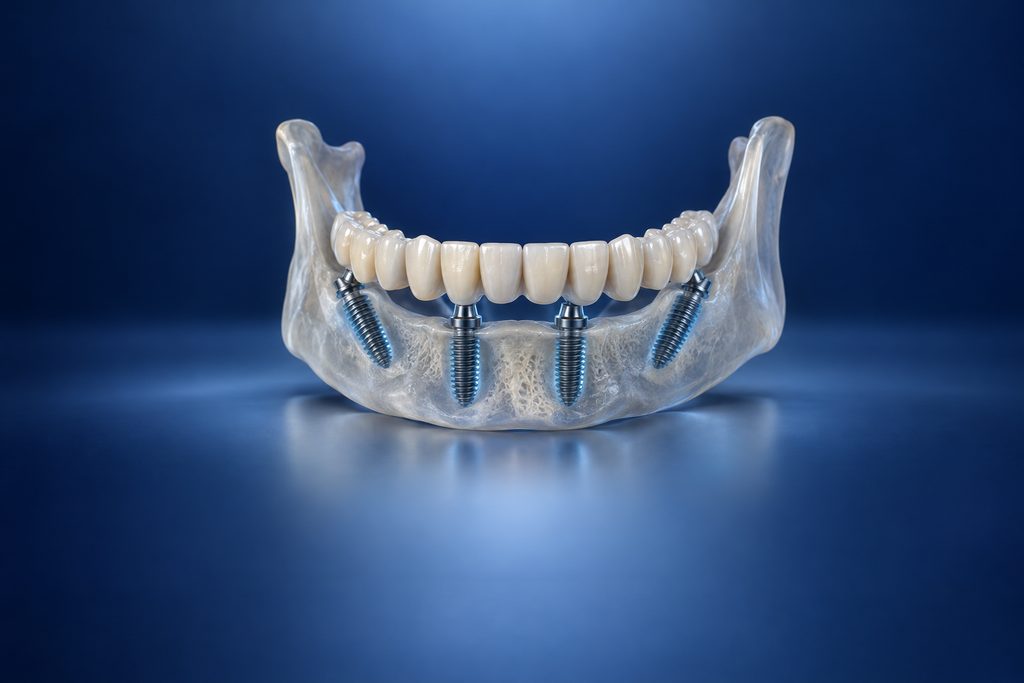
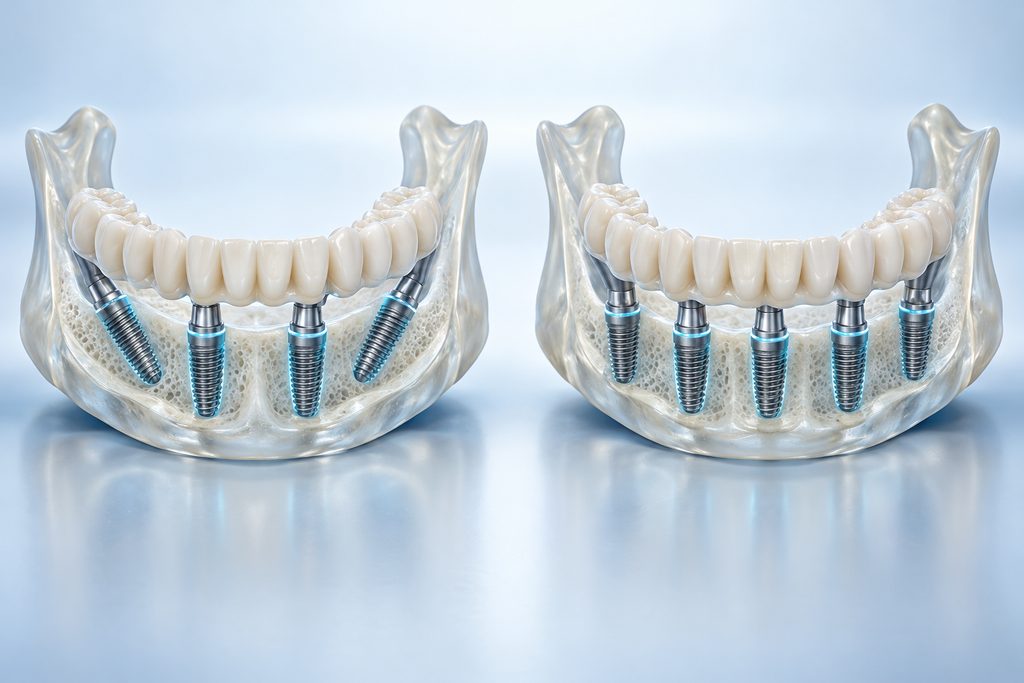
The difference is the number of implants holding the bridge: All-on-4 uses four per jaw and All-on-6 uses six. Both replace every tooth in one jaw with a fixed bridge that is screwed onto the implants, so it never comes out at night.
All-on-4 is a full-arch technique in which four implants hold a fixed bridge: two upright at the front of the jaw and two tilted backwards at up to 45 degrees.
The tilt lets the back implants reach dense bone in front of the sinus or the nerve canal. That spreads support along the arch without needing bone at the very back of the mouth.1
All-on-6 adds two implants, usually further back, so the chewing load is shared across six points. It needs more bone and gives the bridge more support and a safety margin.
Our All-on-4 and All-on-6 treatment guide covers the procedure and full prices. This article is about choosing between the two.
- 93%implant survival, lower jawAll-on-4, up to 18 years
- 94.7%implant survival, upper jawAll-on-4, up to 13 years
- €4,200All-on-4 per arch at DentureAll-on-6: €5,400
- 3–4 monthsbetween the two tripswith fixed temporary teeth
All-on-4 vs All-on-6: how do they compare side by side?
The practical differences at a glance. Every row depends on your scan, so treat this as a starting point, not a diagnosis.
| All-on-4 | All-on-6 | |
|---|---|---|
| Implants per jaw | 4: two upright at the front, two tilted at the back | 6: spread further along the arch |
| Bone needed | Moderate, mainly at the front of the jaw | More, including further back |
| Bone graft or sinus lift | Usually avoided; that is the point of the tilt | Sometimes needed in the upper jaw |
| Typical use | Most lower jaws and many upper jaws | Soft upper bone, long arches, heavy grinders |
| Teeth on the bridge | Usually 10–12 | Usually 12 |
| If one implant fails | The bridge often cannot be held on three | The bridge usually stays on the other five |
| Price per arch at Denture | €4,200 | €5,400 |
| Typical UK private fee | £12,000 | £14,000 |
Neither is better in general. All-on-6 earns its extra cost when your bone, arch or bite needs more support.
How much bone do you need for All-on-4 or All-on-6?
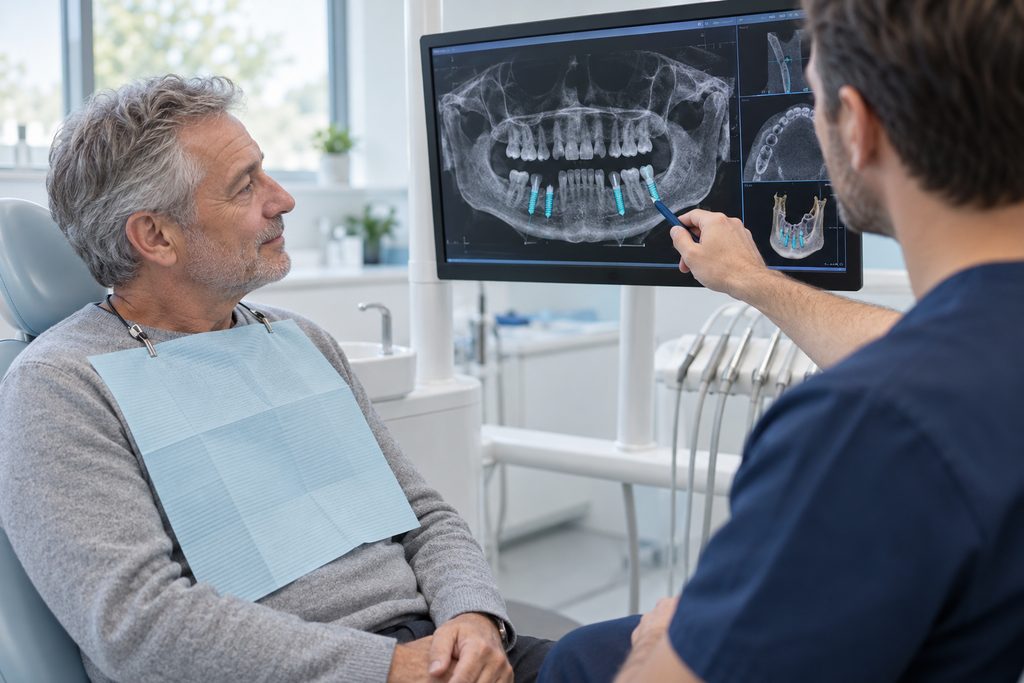
All-on-4 needs a reasonable amount of bone at the front of the jaw; All-on-6 also needs bone further back for two more implants. A 3D CT scan (CBCT) measures this in millimetres before anyone can honestly recommend either.
After teeth are lost the jaw shrinks, most of all at the back, and in the upper jaw the sinus tends to drop into the old molar space. The tilted implants of All-on-4 were designed to work around exactly this.
- Good bone front and back: either option; your bite and arch decide.
- Good bone at the front, little at the back: usually All-on-4, avoiding a graft.
- Thin bone even at the front: a bone graft first, or zygomatic implants anchored in the cheekbone.
Be cautious with any clinic that confirms All-on-4 or All-on-6 from a photo. Without a scan, nobody knows how much bone you have.
Is All-on-6 better for the upper jaw?
All-on-6 is often the better choice for the upper jaw, but not always. Upper bone is softer and more porous than lower bone, so spreading the load over six implants makes sense when the scan shows soft bone and room to place them.
Four implants can still work well in the upper jaw. In a study of 1,072 patients treated with All-on-4 in the upper jaw, 94.7% of implants were still in place after up to 13 years.2
In the lower jaw, a study of 471 patients followed for 10 to 18 years found 93% implant survival and 98.8% bridge survival.1
A systematic review found that fixed full-arch bridges on four to six implants are a well-documented option in both jaws. About 95% of those bridges were still in use at 10 years.4 It does not show that six implants always outlast four.
In our clinic most lower jaws get four implants, and we suggest six more often in the upper jaw. All-on-4 at the bottom with All-on-6 at the top is a common, sensible mix.
Do six implants handle bite force better than four?
Yes, six implants handle bite force better than four, because they share the chewing load between more points. Each implant and screw carries less load, which matters most for people who grind or clench and for bridges that reach far back.
The weak point of any full-arch bridge is the cantilever: the part of the bridge that extends behind the last implant. The longer it is, the more leverage every bite puts on the back implants and screws, so surgeons usually keep it to one or two teeth at most.
All-on-4 manages this by tilting the back implants so they emerge further back, which shortens the cantilever. All-on-6 manages it by placing implants further back in the first place, which can allow full molars on each side.
If you grind, a night guard protects either bridge. Once healed, both let most people eat meat and crisp fruit again, which a removable denture often makes difficult.

Patients often ask for six implants because six sounds safer. Sometimes it is. But two extra implants squeezed into poor bone, or placed after a graft you did not need, are not an upgrade. The scan should decide.
What happens if one All-on-4 implant fails?
If one of four implants fails, the bridge usually cannot be supported on the remaining three, so the implant must be replaced first. With six, the bridge can usually stay on the other five while the failed one is replaced.
Implant failure is uncommon but real. A systematic review of All-on-4 studies counted 74 failed implants out of 4,804, and 74% of those failures happened within the first 12 months.3
In the long-term studies, smoking and earlier infections around implants were linked to more problems.12
While a replacement implant heals, the temporary bridge is usually adapted to the remaining implants; in some cases you wear a denture for 2 to 3 months. At Denture, implants carry a lifetime written warranty, provided you keep to your check-ups.
Later problems usually come from peri-implantitis, an infection of the gum and bone around an implant, driven by plaque.6 Our implant aftercare guide covers the first weeks day by day.
What is the difference between the temporary and the final bridge?
The temporary bridge is light acrylic and only lasts while the implants heal; the final bridge is stronger, looks more natural and is fitted 3 to 4 months later. The temporary goes in within about 72 hours of surgery, with four implants or six.
Immediate loading means fixing teeth onto implants within days of placing them, rather than waiting months. It is why you leave the first trip with fixed teeth, but it only works when each implant is held firmly in the bone on the day of surgery.
The temporary bridge is deliberately simple and designed to be replaced. In the long-term upper-jaw study, mechanical problems such as chipped or broken teeth affected 58.8% of temporary bridges, against 7.3% of final bridges.2 The final material deserves as much thought as the number of implants.
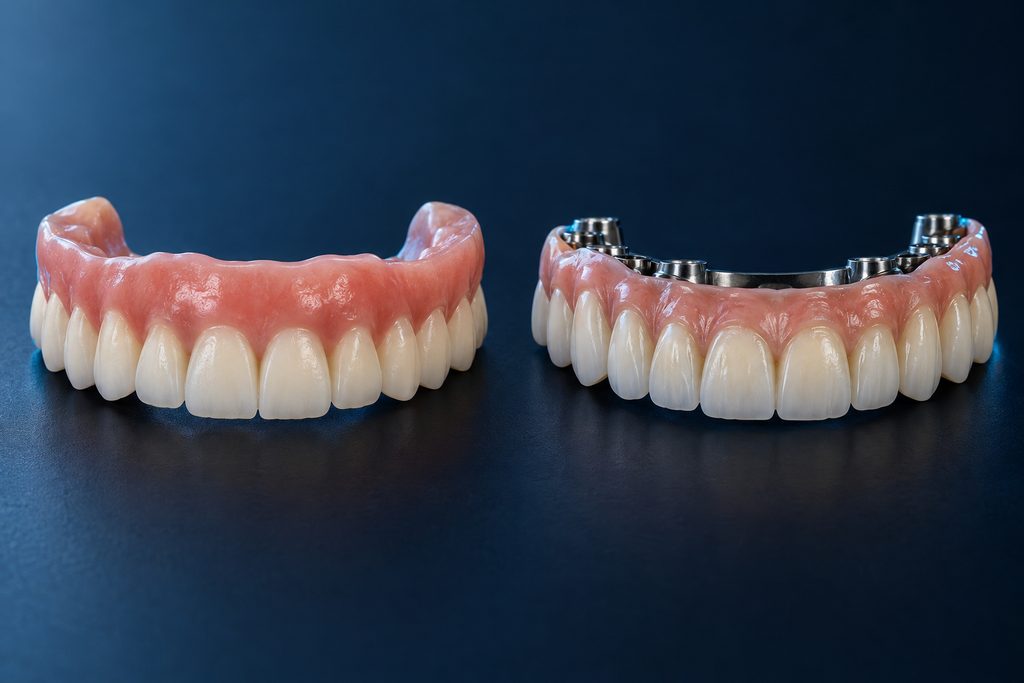
Zirconia vs acrylic: which full-arch bridge material should you choose?
The temporary bridge is acrylic; the final bridge is usually one of the other two.
| Acrylic (temporary) | Acrylic on a titanium bar | Zirconia on a titanium barOur final bridge | |
|---|---|---|---|
| Used for | The first 3–4 months | Final bridge, lower-cost option | Final bridge |
| Appearance | Good, but less lifelike | Good; teeth can stain over time | Natural translucency, holds its colour |
| Strength | Can chip or crack under load | Strong frame; the acrylic teeth wear | Very hard; resists wear and staining |
| Repairs | Quick and simple | Teeth can be renewed on the frame | Small chips polished; a fracture means a remake |
| Typical lifespan | Months, by design | About 5–8 years before the teeth are renewed | 10–15 years or more expected |
For both All-on-4 and All-on-6, our final bridge is monolithic zirconia (milled from a single block) on a titanium bar, with a 10-year written warranty. If a quote does not name the final material, ask before paying a deposit.
How do you clean and maintain a full-arch bridge?
You clean under the bridge every day and see a hygienist at least twice a year, with four implants or six. Once a year a dentist unscrews the bridge, cleans it and checks every implant.
Daily care means a soft toothbrush twice a day and a water flosser or floss threaded under the bridge. Six implants mean six sites to clean instead of four, a little more work for less load on each.6
Ask which implant system you are getting and whether a dentist at home can order parts. With Straumann® or Nobel Biocare® the answer is almost always yes.
How much do All-on-4 and All-on-6 cost per arch?
At Denture in 2026, All-on-4 costs €4,200 per arch and All-on-6 costs €5,400 per arch, including the temporary and final zirconia bridges, hotel and airport transfers on both trips. All-on-4 on both jaws costs €8,400.
Typical private fees in the UK in 2026 are about £12,000 per arch for All-on-4, £14,000 for All-on-6 and £24,000 for both arches with four implants each. Before flights, that makes Istanbul roughly two thirds cheaper.
Implants are rarely available on the NHS, usually only for people who cannot wear dentures after mouth cancer or an accident.5
The difference between the two prices pays for two extra implants and their parts. For comparison, a single implant with a crown is €550 at Denture and about £1,500 privately in the UK.
Some lower quotes leave out the final bridge, the scan or the second trip. See our guide to comparing cheap implant quotes and our honest guide to dental treatment in Turkey.
How long do you need to stay in Istanbul for each trip?
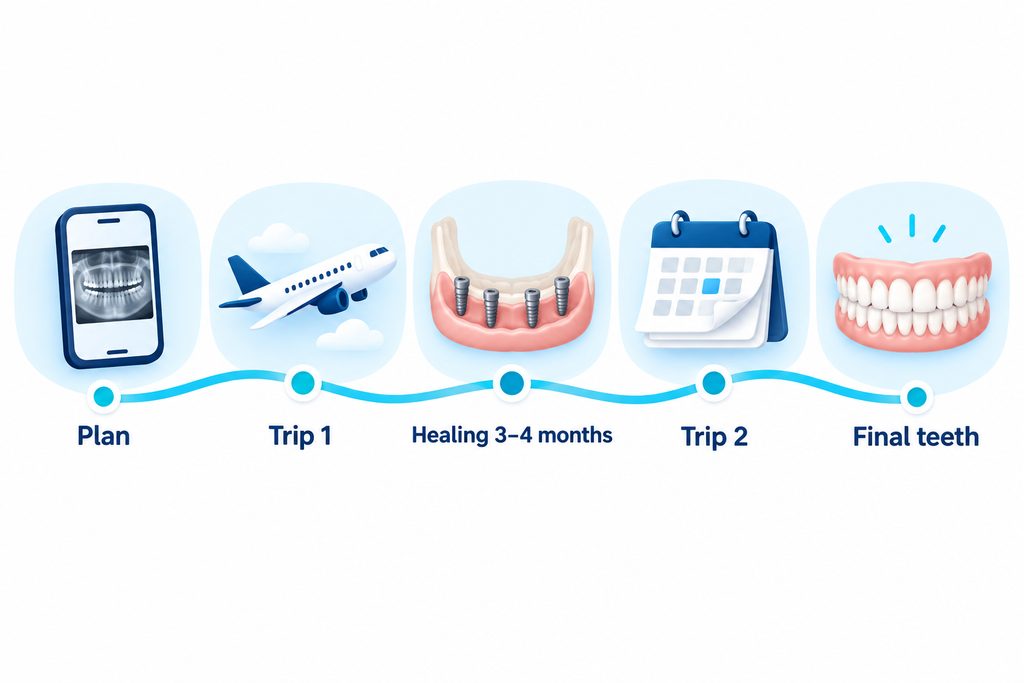
Plan for two trips to Istanbul: about 5 days for surgery and fixed temporary teeth, then about 4 days for the final bridge 3 to 4 months later. The schedule is almost the same for All-on-4 and All-on-6.
The gap lets bone grow onto each implant, so be wary of a final bridge promised within one week. All-on-6 takes longer only if a sinus lift or graft is needed first, which can add 4 to 6 months and a third trip.
Flights take about 4 hours from London. UK, Irish and most EU passport holders need no visa for stays up to 90 days in 180 days, but check the current rules for your passport before you book. Our Istanbul dental trip itinerary helps you plan rest days.
What happens on each trip, step by step?
A typical plan for one arch. Both arches can usually be treated in the same two trips.
- Trip 1 · Day 1
CT scan and the final decision
Your implantologist shows you the planned implant positions on the scan and confirms four or six before you sign.
- Trip 1 · Day 2
Extractions and implant surgery
Failing teeth are removed and the implants placed under local anaesthetic, with IV sedation if you prefer.
- Trip 1 · Days 3–5
Fixed temporary bridge
An acrylic bridge is screwed in within about 72 hours. Over the next two days you learn to clean under it, then fly home with fixed teeth.
- At home
Healing
Soft food for 8 to 12 weeks while the implants bond to the bone, with video check-ups. Call the clinic if anything feels loose or swollen.
- Trip 2 · Days 1–4
Final zirconia bridge
A try-in so you approve shape and shade, then the final bridge is screwed in and the bite adjusted.
Who is a good candidate for All-on-4 or All-on-6?
Full-arch implants are major surgery for people who have lost, or are about to lose, all the teeth in one jaw.
A good fit if you have
- All or most teeth in one jaw missing or beyond repair
- A denture that moves or stops you eating what you want
- Enough bone at the front of the jaw on a 3D scan (All-on-4)
- Soft upper bone, a long arch or a grinding habit (All-on-6)
- Good health, or well-controlled diabetes and blood pressure
Better options if you have
- Several healthy teeth that can be savedSingle implants or an implant bridge
- Thin bone even at the front of the jawA bone graft first, or zygomatic implants
- Heavy smoking you cannot pauseStop around surgery, or consider a denture
- Bisphosphonate bone drugs by drip, or jaw radiotherapySpecialist advice; implants often not advised
- Uncontrolled diabetesStabilise with your GP first
What should you do next?
Start with your own X-ray and a written plan, not a price list.
- Get a recent panoramic X-ray from your dentist; it is enough for a first opinion.
- Ask for a plan that names four or six implants and why. Use our free treatment plan form; a specialist replies within 24 hours.
- Compare like with like: implant brand, final bridge material, both trips and warranty, against our All-on-4 prices and process.
- Check the clinic, not just the country. Read is dental work in Turkey safe.
Frequently asked questions
Not automatically. All-on-6 spreads the load and keeps the bridge in place if one implant fails, which helps with soft upper bone and grinding. All-on-4 has strong long-term evidence and often avoids bone grafts, so your scan and bite should decide.
At Denture, All-on-6 is €5,400 per arch and All-on-4 is €4,200 per arch, both with temporary and final bridges, hotel and transfers. Typical UK private fees are about £14,000 and £12,000. The difference pays for two extra implants and their parts.
Yes, if the scan shows enough bone at the front of the upper jaw. A long-term study of more than 1,000 upper-jaw patients found 94.7% of implants still in place after up to 13 years. Surgeons suggest six implants more often here because upper bone is softer.
Sometimes. Six implants need bone further back, and in the upper jaw that can mean a sinus lift. If you would need a graft for six implants but not for four, All-on-4 is often the simpler choice.
The implant is removed, the site heals and a new implant is placed before the bridge is refitted. Meanwhile the temporary bridge is adapted, or you wear a denture for 2 to 3 months. At Denture implants carry a lifetime written warranty, subject to check-ups.
Usually 10 to 12, depending on how far back the implants can support it. All-on-6 bridges usually carry 12 teeth, sometimes with full molars at the back.
For the final bridge, usually yes. Zirconia resists wear and staining and is expected to last 10 to 15 years or more. Acrylic teeth on a titanium frame usually need renewing after 5 to 8 years, though acrylic remains the right choice for the temporary bridge.
Yes, it is a common combination. Dense lower bone usually suits four implants, while the softer upper jaw often benefits from six, and both arches can be treated in the same two trips.
Your implant surgeon, using a 3D CT scan, your medical history and the way you bite. You should see the planned implant positions and understand the reasons before you sign.
Sources
- The All-on-4 treatment concept for the rehabilitation of the completely edentulous mandible: a longitudinal study with 10 to 18 years of follow-upMaló P. et al., Clinical Implant Dentistry and Related Research, 2019
- The All-on-4 concept for full-arch rehabilitation of the edentulous maxillae: a longitudinal study with 5–13 years of follow-upMaló P. et al., Clinical Implant Dentistry and Related Research, 2019
- The all-on-four treatment concept: a systematic reviewPatzelt S.B.M. et al., Clinical Implant Dentistry and Related Research, 2014
- What is the optimal number of implants for fixed reconstructions: a systematic reviewHeydecke G. et al., Clinical Oral Implants Research, 2012
- Dental treatments: dental implantsNHS (UK)
- Dental implantsOral Health Foundation (UK)