
Is dental work in Turkey safe?
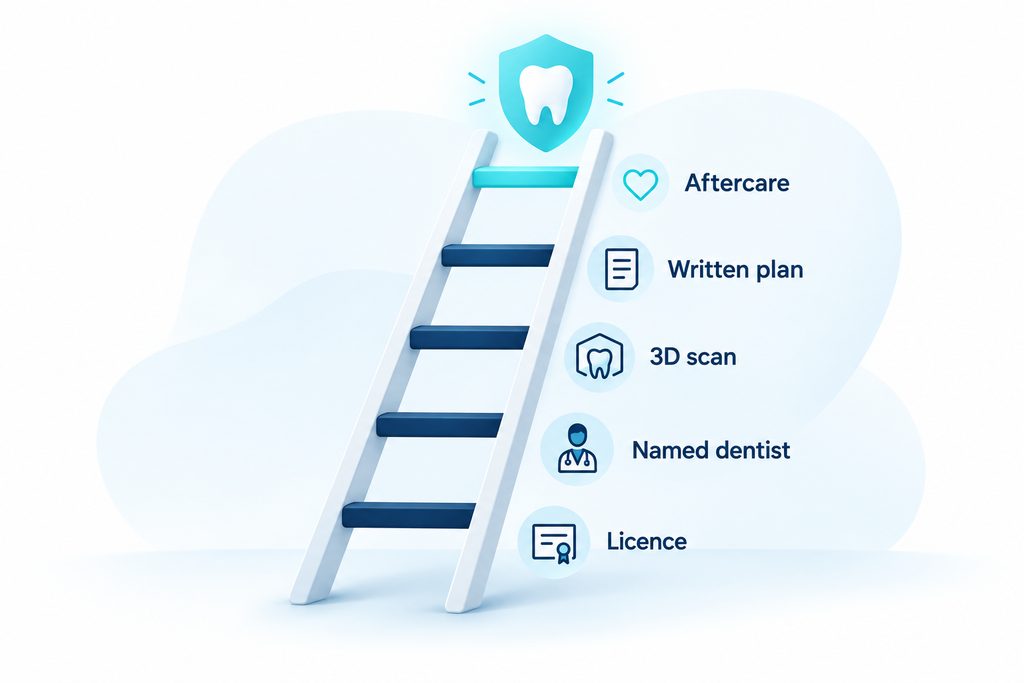
Dental work in Turkey can be as safe as at home if a named specialist at a licensed clinic plans it from X-rays or a 3D scan, in writing. Standards vary widely between clinics, and the main risks are over-treatment, rushed timelines and aftercare gaps, such as implants loaded before the usual 3 to 6 months of healing. Our guide to dental treatment in Turkey covers costs and planning; this post checks each risk and how to reduce it.
- Clinic licence
- Ministry of Health
- Dentist registration
- Regional chamber, TDB
- Main risk
- Over-treatment
- Implant healing
- 3–6 months, 2 trips
- Flight from London
- About 4 hours
- Premium implant
- €550 vs about £1,500 UK
Key takeaways
- Turkish clinics are licensed by the Ministry of Health and dentists must be registered with a dental chamber, but a licence is a minimum standard, not proof of good care.
- The realistic risks are over-treatment, rushed timelines and aftercare gaps; infection and implant failure are uncommon at careful clinics.
- The GDC cannot act on complaints about dentists abroad, so your protection is the clinic’s warranty, Turkish complaint routes and your own records.
- Do not travel for one small treatment, with untreated gum disease or with uncontrolled diabetes; a careful clinic will tell you to wait.
So, is dental work in Turkey safe?
Dental work in Turkey is safe at a licensed clinic where a named, qualified dentist plans your treatment from X-rays or a 3D scan. That dentist should also use named materials and stay in touch after you fly home.
Dental work in Turkey is not safe by default, because standards vary widely between clinics. Some practices match good clinics in London or Dublin, while some high-volume operations put speed and sales before your teeth.
As an oral surgeon, I see both ends of that range. This post checks regulation, hygiene, the realistic risks and your legal position, and how to reduce each risk.
One point before the detail. The country is rarely the problem. The clinic, the dentist and the plan decide whether your treatment is safe.
- 5 yearsdental degreeplus 3–4 years for specialists
- 3–6 monthsimplant healingbetween two trips
- ~4 hflight from Londonso follow-up visits are realistic
- 24 hto a written planfrom a named specialist at Denture
How are dental clinics regulated in Turkey?
Dental clinics in Turkey are licensed and inspected by the Ministry of Health.4 Every dentist must also hold a dental degree and be registered with a regional dental chamber before they can practise.5
There are three layers of oversight worth knowing about:
- The clinic licence. Private dental clinics, polyclinics and oral and dental health centres work under a Ministry of Health licence that sets rules for rooms, equipment, staff and sterilisation, checked at inspections.
- Health tourism authorisation. A health tourism authorisation certificate is a separate Ministry of Health permit that a clinic needs before it may treat patients who travel from abroad for care. It adds rules on interpreters, patient information and complaints.
- The dentist’s registration. Dentists qualify after a five-year degree and must join their regional dental chamber, part of the Turkish Dental Association (TDB). Specialists train for three to four more years.
Regulation sets a floor, not a ceiling. A licence does not tell you whether a particular dentist is careful, or whether your plan is right for you. Our guide to checking Turkish dentists’ qualifications shows how to verify both yourself.
Are hygiene and sterilisation standards in Turkish clinics safe?
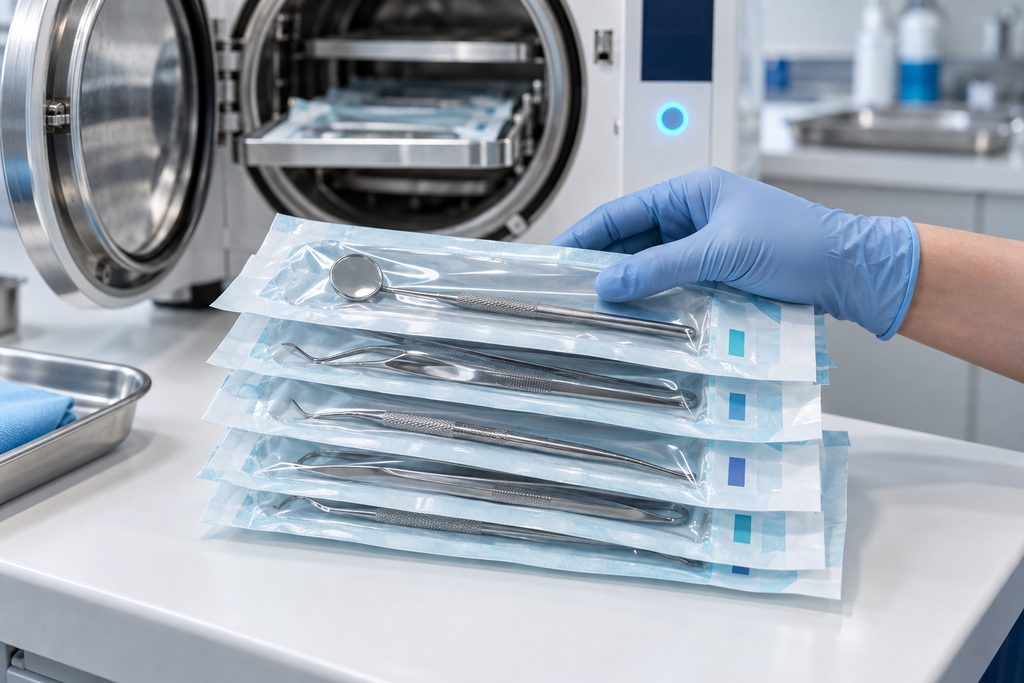
Hygiene and sterilisation at a well-run Turkish clinic follow the same principles as in the UK, though standards vary between clinics. Instruments are cleaned, sealed in pouches and sterilised in a steam autoclave, and single-use items are thrown away after one patient.
The UK benchmark for dental practices, the HTM 01-05 guidance, describes the same steps.6
The weak point is rarely the equipment but discipline on busy days. You can check a few things yourself:
- Instruments are opened from a sealed pouch in front of you, not taken from a tray that was already laid out.
- The dentist and nurse put on fresh gloves for you and wear masks and eye protection.
- The chair and surfaces are wiped down between patients, and the room looks orderly rather than rushed.
- For implant surgery, the implant arrives in its sealed, labelled sterile package.
It is fair to ask whether a clinic uses a vacuum (Class B) autoclave, which removes air first so steam reaches inside hollow instruments and sealed pouches. A careful clinic will explain, or show you the sterilisation room, without hesitation.
Are the implants and materials used in Turkey genuine?
Implants and materials at reputable Turkish clinics are genuine, but you should not have to take that on trust. Ask in writing for the brand of every implant and the material of every crown or veneer, and keep the implant labels after surgery. Genuine implant systems carry lot numbers and come with stickers that record exactly what was placed.
Prices tell part of the story. At Denture, a premium-brand implant with its abutment (the post that holds the crown) and a zirconia crown is €550, against about £1,500 in a UK private clinic. An E-max veneer starts at €220, against about £950 in the UK.
Genuine premium implants and ceramics are not much cheaper for a Turkish clinic than for a British one. Most of the saving comes from lower salaries, lower rent and an in-house lab, not from cheaper parts.
Our dental implants guide and E-max veneers page list exactly what each price includes. A quote far below figures like these is a reason to ask which implant brand, which lab and which ceramic you are paying for.
What are the real risks of dental work in Turkey?
A plain risk check. “How likely” is Denture’s clinical judgement from patients who travel for treatment, not a measured rate. It depends heavily on the clinic you choose.
| How likely | What it looks like | How to reduce it | |
|---|---|---|---|
| Over-treatment | Common at high-volume clinics | Crowns on healthy teeth, more units than you need | Ask why each tooth needs treatment; get a second opinion at home |
| Rushed timelines | Fairly common | Implants loaded too early, a full mouth done in a few days | Allow 3–6 months between implant trips unless your scan supports immediate teeth |
| Infection after surgery | Uncommon | Swelling, pain or discharge days after implants or extractions | Sterile technique, clear aftercare instructions, antibiotics only if prescribed |
| Implant failure | Uncommon, and it happens at home too | An implant that does not fuse to the bone or works loose | Planning on a 3D scan, no smoking, follow-up visits, a written warranty |
| Miscommunication | Fairly common | A plan or a result you did not expect | A written, per-tooth plan and a preview or mock-up before treatment |
| Aftercare gaps | Common | Nobody to see when a crown feels high or a gum is sore at home | Agree video check-ups and a local dentist before you travel |
| Travel health | Rare | Flying too soon after a sinus lift; blood clots in the legs on long journeys | Follow written flying advice; walk about and drink water on the flight |
Most of these risks belong to the clinic and the plan, not the country. Over-treatment is the story behind “Turkey teeth” and what went wrong.
How likely are infection and implant failure?
Infection and implant failure are both uncommon at careful clinics. Serious infection after dental surgery is rare when sterile technique is followed.
A large research review found that about 95 in 100 single implants were still in place 10 years after they were placed.7
Those figures come from well-planned cases. The risk rises with smoking, uncontrolled diabetes, untreated gum disease, thin bone and surgery planned without a 3D scan.
Osseointegration is the process in which the jawbone grows onto the implant surface and locks it in place. It usually takes 3 to 6 months, which is why implants normally need two trips. A clinic that promises permanent teeth on new implants within a week, for everyone, is skipping that step for some patients.
Warning signs after surgery include swelling that gets worse after day 3, a fever, a bad taste or discharge, and an implant that feels loose. Our day-by-day implant aftercare guide explains what is normal in the first two weeks.
Most of the work I am asked to correct was not caused by dirty instruments or fake implants. It was caused by a plan nobody questioned. Ask why each tooth needs treatment, and expect a clear answer.
What do the GDC, NHS and BDA say about treatment abroad?
The GDC, NHS and BDA do not tell people never to go abroad for dental treatment. They advise you to research the clinic, understand the risks and plan your aftercare.
The General Dental Council points out that it regulates only dental professionals registered in the UK, so it cannot investigate a complaint about a dentist in Turkey.1
The NHS treatment abroad checklist asks you to check the qualifications of the team treating you and to be clear how your aftercare will work. It names a hard sell, a lack of information and no mention of aftercare as warning signs.2
The British Dental Association warns that UK dentists often see patients with complications after treatment abroad, most often with crowns and implants.3
The UK government’s travel advice for Turkey covers entry rules and health, and is worth reading before you book.8 Our view matches theirs: travel for larger treatments, after doing the checks.
What are your rights if dental work in Turkey goes wrong?
If dental work in Turkey goes wrong, your main rights are against the Turkish clinic, because your contract is with that clinic and usually falls under Turkish law. UK complaint bodies such as the GDC cannot act on the treatment itself. In practice, your protection comes from four places, and it is worth knowing them before you pay.
- The clinic’s written warranty. At Denture this is 10 years on veneers and crowns and lifetime on implants, with conditions such as regular check-ups and a night guard where prescribed. Check whether remakes include flights and a hotel.
- Turkish complaint routes. You can complain to the Ministry of Health about a clinic and to the regional dental chamber about a dentist’s conduct. Clinics authorised for health tourism must have a process for international patients’ complaints.
- Professional insurance. Dentists in Turkey must carry compulsory malpractice insurance, which can pay compensation where negligence is proven, usually through the Turkish courts.
- Your card provider. Paying by credit card can add protection. In the UK, Section 75 of the Consumer Credit Act can apply to purchases abroad within set limits. Ask your card provider before you pay.
Cross-border legal action is slow and costly, so a clinic that fixes problems quickly matters more. Keep copies of your plan, consent forms, X-rays, invoices and implant labels: every route above depends on them.

When should you not travel to Turkey for dental work?
Do not travel when the treatment is too small to justify the trip, or when your health makes surgery or a short, intensive treatment window risky. In these cases staying at home is usually safer, cheaper or both.
- One filling, one crown or a check-up. The saving rarely covers flights and time off work.
- Untreated gum disease. Crowns, veneers and implants placed on inflamed gums fail sooner; get the gums treated and stable first.
- Uncontrolled diabetes or another condition that slows healing, until your doctor confirms it is under control.
- Blood thinners or bone medicines such as bisphosphonates (often taken for osteoporosis), unless your doctor agrees and the surgeon has seen your full medication list.
- Pregnancy, for anything beyond urgent care.
- A plan you do not understand, or pressure to commit before you have it in writing.
If one of these applies, a careful clinic will tell you to wait. Being told “not yet” is a sign of a good clinic, not a lost sale.
How can you make dental treatment in Turkey safer?
Nine checks that cover the risks in the table above. Tick them off before you pay a deposit anywhere.
Who looks after you once you are back home?
Your Turkish clinic should look after you once you are home, with your local dentist as a backup, and both should be arranged before you travel. Aftercare gaps are common because they are easy to overlook while you focus on the treatment.
At Denture, patients have video check-ups after they return, send photos when something feels wrong, and receive their records to share with their own dentist. Small issues, such as a crown that feels high or a sore gum, are usually sorted on a call or by a local dentist with our notes.
Before you book anywhere, ask three questions: who answers when you message from home, how fast they reply, and what happens if a remake is needed. If the answers are vague, the aftercare will be too.

What should you do next?
Decide whether the trip makes sense for your treatment, then check the clinic and the plan before you pay anything.
- Get a check-up at home if your gums or general health need attention first.
- Read up on your treatment. Our implant treatment page and veneers treatment page explain what is included and how long each takes.
- Check the clinic and the dentist with the checklist above and our guide to verifying a Turkish dentist’s licence.
- Ask for a written plan. Send us a photo or X-ray and a specialist replies within 24 hours with an itemised plan and a fixed price.
- Show the plan to your own dentist before you book flights. A sound plan holds up to a second opinion.
Frequently asked questions
It can be, if you choose a licensed clinic with a named, qualified dentist, a plan based on X-rays or a scan, and aftercare arranged before you travel. Standards vary widely between clinics, so the checks you do before booking matter more than the country.
Yes. Clinics are licensed and inspected by the Turkish Ministry of Health, and clinics that treat foreign patients need a separate health tourism authorisation. Dentists must be registered with a regional dental chamber to practise.
Reputable clinics use genuine, traceable implant systems, and each implant comes with a label showing its brand and lot number. Ask for the brand in writing before treatment and for the labels afterwards; a clinic that refuses is a red flag.
The most common problem is over-treatment: more crowns or veneers than you needed, often on healthy teeth. Rushed timelines and poor aftercare come close behind, while infection and implant failure are less common.
No. The General Dental Council regulates only dental professionals registered in the UK, so it cannot act on a dentist in Turkey. Complaints go to the clinic first, then to the Turkish Ministry of Health or the regional dental chamber.
Check its Ministry of Health licence, the name and registration of the dentist who will treat you, and whether you receive an itemised plan based on X-rays. Ask how instruments are sterilised and what aftercare you get at home.
Yes, when they are planned on a 3D scan and placed by an implantologist or oral surgeon, with time to heal before the final crowns. Expect two trips 3 to 6 months apart in most cases.
Contact your clinic straight away, and see a local dentist or urgent care service if you have spreading swelling, a fever or worsening pain. Do not wait for a video call if symptoms are getting worse.
Standard travel insurance usually excludes planned treatment and its complications. Look for specialist medical travel cover and check what the clinic’s own warranty includes.
Most trips to Istanbul are trouble-free, but read the UK government’s travel advice for Turkey and take normal city precautions. Check the current entry rules for your passport before you book flights.
Sources
- Going abroad for dental treatmentGeneral Dental Council (UK)
- Treatment abroad checklistNHS (UK)
- Dental tourism: patients need to know the risksBritish Dental Association
- Licensing of private health facilities and international health tourismRepublic of Türkiye Ministry of Health
- Türk Diş Hekimleri Birliği (Turkish Dental Association)Turkish Dental Association (TDB)
- Decontamination in primary care dental practices (HTM 01-05)Department of Health and Social Care (UK), 2013
- Systematic review of the survival rate and the incidence of biological, technical, and aesthetic complications of single crowns on implants reported in longitudinal studies with a mean follow-up of 5 years (Jung et al., Clinical Oral Implants Research)Clinical Oral Implants Research, 2012
- Foreign travel advice: TurkeyForeign, Commonwealth & Development Office (GOV.UK)