

Are Turkish dentists qualified?
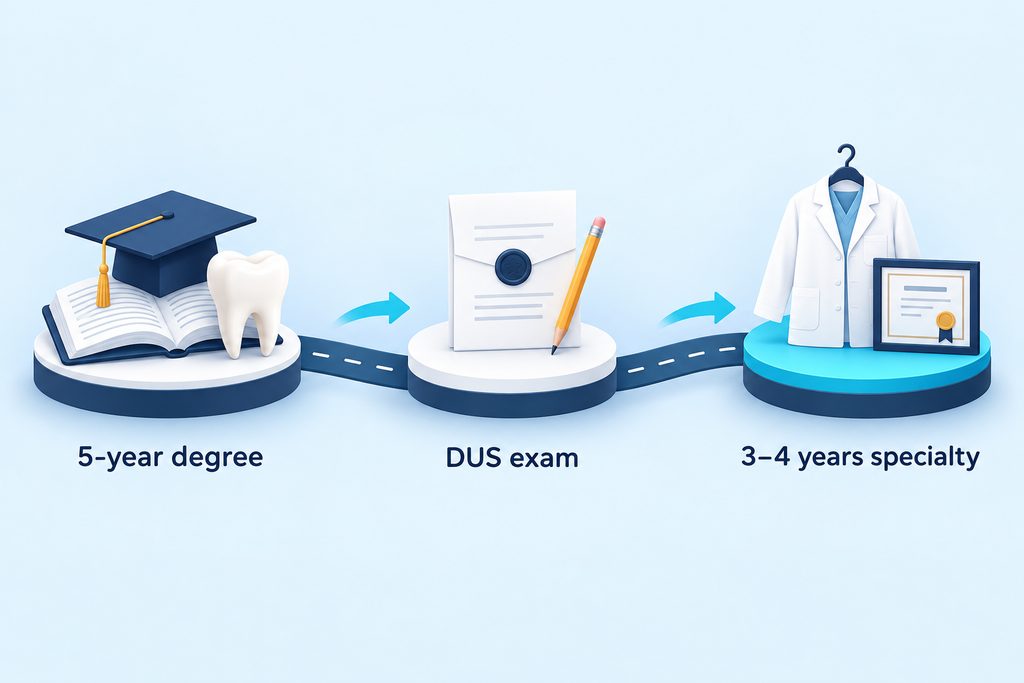
Yes: every dentist in Turkey must hold a 5-year dental degree registered with the Ministry of Health, and recognised specialists train for 3 to 4 more years after a national exam. A diploma does not tell you how a particular clinic plans and treats, and standards vary widely, so confirm the named dentist, their specialty and the clinic licence yourself. This guide shows you how, and our honest guide to dental treatment in Turkey covers costs, travel and aftercare.
- Dental degree
- 5 years at a dental faculty
- Specialist training
- 3–4 years after the DUS exam
- Clinic licence
- Ministry of Health, via the province
- Chamber membership
- Required for private dentists
- Not specialties
- Implantology, cosmetic dentistry
- UK and EU recognition
- Not automatic
Key takeaways
- Turkish dentists train for 5 years, as in the UK. Specialists pass a national exam (DUS) and train for 3 to 4 more years.
- Get the full name of your dentist, then check their specialty, chamber membership and the clinic’s Ministry of Health licence.
- ITI, EAO and course certificates show interest, not a licence. Implantology and cosmetic dentistry are not specialist titles.
- Talking only to a coordinator, never to a named dentist, is the clearest red flag.
How are dentists trained and licensed in Turkey?
Every dentist in Turkey must complete a five-year university degree at a faculty of dentistry and then register their diploma with the Ministry of Health before they can treat patients. That is the same length of undergraduate training as in the UK and most of Europe.
Students enter dental school from secondary school through Turkey’s national university entrance exam, where dentistry needs a high score. The early years cover medical sciences and work on models; later years are spent treating patients in the faculty’s clinics under supervision.
Graduates receive the title diş hekimi (dentist), which clinics usually translate as DDS. With a registered diploma, a dentist may work in a public hospital, open a private practice or join a clinic.
One honest caveat: the number of dental faculties in Turkey has grown quickly, and the Turkish Dental Association has publicly raised concerns about student numbers rising faster than teaching capacity.1 So it is reasonable to ask where and when your dentist trained, as you would at home.
- 5 yearsdental degreerequired of every dentist
- 3–4 yearsspecialty trainingafter the national DUS exam
- 8recognised specialtiesin Turkish regulation
- 3 typesof licensed clinicpractice, polyclinic or centre
What does a specialist dentist title mean in Turkey?
A specialist title in Turkey means the dentist passed a national entrance exam and then completed three to four years of supervised training in one recognised field. It is a protected title: a general dentist may not call themselves a specialist.
DUS is the national entrance exam for dental specialty training in Turkey, set by ÖSYM, the state body that also runs the university entrance exam.3 Places are limited, and training takes place in university faculties or teaching hospitals.
The recognised dental specialties are:
- Oral and maxillofacial surgery: extractions, bone grafts, sinus lifts and jaw surgery.
- Prosthodontics: crowns, veneers, bridges and dentures.
- Periodontology: gums and the bone around the teeth.
- Orthodontics: braces and clear aligners.
- Endodontics (root canals), restorative dentistry (fillings and repairs), paediatric dentistry (children) and oral and maxillofacial radiology (dental X-rays and scans).
Notice what is missing. Implantology and cosmetic dentistry are not specialties in Turkey, just as they are not in the UK. An “implantologist” or “smile designer” is describing a focus and extra training, which can be extensive, not a licensed title.
For implants, look for an oral surgeon, a periodontist or a dentist with documented implant training and many cases. Our dental implants guide explains how the surgery and the crown are planned.
Some senior dentists also hold a PhD from a dental faculty. If a dentist lists one, ask in which field it was earned.
At Dentsway, our prosthodontist and oral surgeon are recognised specialists with PhDs from Marmara University.
Which dental titles and memberships actually mean something?
What you are likely to see on a clinic website or a certificate wall, and how much weight each one carries.
| Who grants it | What it proves | What it does not prove | |
|---|---|---|---|
| Dental degree (DDS, diş hekimi) | A university dental faculty | Five years of training | Experience with your treatment |
| Ministry of Health registration | Ministry of Health | The right to practise in Turkey | Any specialty |
| Specialist title (uzman) | Training faculty or hospital, after DUS | 3 to 4 years of training in one field | Skill outside that field |
| PhD (doktora) | A university dental faculty | Years of research in a named field | Clinical volume or recent practice |
| Dental chamber membership | Regional chamber of the TDB | Registered to practise privately in that region | Quality of work |
| ITI Fellow | International Team for Implantology | Selected by peers for contribution to implant dentistry | A specialist title or a licence |
| ITI or EAO member | Open membership for a fee | An interest in implant dentistry | Any assessment of skill |
| Course or brand certificate | A course provider or manufacturer | Attendance, often for one to five days | Competence, a licence or a specialty |
The first three rows are the ones that decide who may treat you. Everything below them is useful context, never a substitute.
How are dental clinics licensed in Turkey?
Private dental clinics in Turkey must hold a Ministry of Health licence, issued through the provincial health directorate.2 Inspectors check them against a regulation written for private oral and dental health facilities. A clinic without that licence may not operate, however modern it looks.
You will meet three main types of facility:
- Private practice (muayenehane): a dentist’s own practice, usually one or two chairs.
- Polyclinic (poliklinik): a larger clinic with several dentists.
- Oral and dental health centre (ağız ve diş sağlığı merkezi): the largest type, with more dentists, chairs and on-site services.
Polyclinics and centres must name a responsible manager (mesul müdür), a dentist who is legally accountable to the Ministry for how the clinic is run, from sterilisation to staff qualifications.
Clinics that treat patients from abroad also need an international health tourism authorisation from the Ministry, and agencies selling treatment on a clinic’s behalf need their own. Dentsway holds this authorisation. Turkish law also requires dentists to carry professional liability insurance, so it is fair to ask any clinic to confirm the cover.
How can I check a Turkish dentist’s licence myself?
You can check a Turkish dentist in four steps: get their full name, ask for their documents, confirm their chamber membership and cross-check their specialty. Turkey has no single English-language online register like the UK’s, so it takes a few emails rather than one search.
- Get the full name, spelled as on the diploma. Turkish names use letters such as ı, ş, ğ and ç, and a search for “Sahin” may miss “Şahin”.
- Ask for copies of the diploma and the specialist certificate. A genuine clinic will share them or show them on a video call. Check that the university, field and name match the website.
- Confirm chamber membership. Dentists in private practice must be members of a regional dental chamber of the Turkish Dental Association (TDB), such as the Istanbul Dental Chamber.1 Ask for the membership number and email the chamber to confirm it.
- Cross-check the specialty and any PhD. Academics are usually listed on their faculty’s staff pages, and a dentist who mentions research should have papers on PubMed or Google Scholar under the same name.
None of this is rude, and a clinic that is proud of its team will answer quickly. If a clinic refuses or gives vague answers, you have learned something important.

How do I check that a dental clinic in Turkey is licensed?
To check a Turkish dental clinic’s licence, ask for its licence type and number, the issuing provincial health directorate and the name of its responsible manager. Then check that they match the address you will visit. A licensed clinic can give you all four in one email.
For clinics that market to international patients, also ask for the health tourism authorisation. HealthTürkiye, the official health tourism portal, is a useful starting point for authorised providers.7 A clinic missing from it is not proof of a problem, but it is a reason to ask for the certificate.
Then do the simple checks that catch most problems:
- The address is a clinic, not a hotel room or a “partner location” revealed on arrival.
- The company that takes your money is the clinic, or an authorised agency named in writing.
- Reviews mention dentists by name, consistently, over several years.
A licence shows the clinic meets the legal minimum, not how it treats patients. For the other risks of treatment abroad, read our dentist’s risk check on dental work in Turkey.
Is a Turkish dental degree recognised in the UK or EU?
A Turkish dental degree is not automatically recognised in the UK or the EU. A dentist who qualified in Turkey must pass a registration exam before they can practise in the UK, usually the General Dental Council’s Overseas Registration Exam.4
The EU recognises dental degrees from its member states automatically under Directive 2005/36/EC.5 Turkey is not an EU member, so Turkish degrees are not covered. A Turkish dentist who wants to work in Germany, the Netherlands or France goes through that country’s own recognition process.
For you, this means two practical things:
- Your Turkish dentist will not usually be on the GDC register, and that is normal. They are regulated under Turkish law, so the checks in this guide are the ones that apply.
- UK and EU regulators cannot act on complaints about treatment in Turkey. Your protection is the clinic’s licence, the dentist’s registration and insurance, and the written guarantee you agree before treatment.
None of this says a Turkish degree is weaker. It reflects separate legal systems: a UK-trained dentist cannot simply start treating patients in Istanbul either.

Do ITI or EAO memberships make a dentist better?
Membership of the International Team for Implantology (ITI) or the European Association for Osseointegration (EAO) does not, on its own, make a dentist better. Both societies are open to dental professionals who pay a fee.68 Membership shows interest and access to education, not tested skill.
Two things carry more weight. An ITI Fellow is nominated and selected by existing Fellows for their contribution to implant dentistry: selective, though still not a licence or a specialist title. And a dentist who presents or publishes at these societies has had their work reviewed by peers.
Be more cautious with certificates from manufacturers and short courses. They prove attendance, and “provider” tiers usually reflect how many cases a clinic has ordered. Useful context, but ask about the dentist’s own training and results too.
A diploma tells you a dentist was trained. It does not tell you how they plan, how many cases like yours they treat, or whether they will say no when a treatment is not needed. Ask to speak to the dentist, not just the coordinator.
Are qualifications enough, or does experience matter more?
Qualifications are the minimum; experience with your specific treatment, and honest planning, matter just as much. A fully qualified dentist can still over-treat, rush a case or take on work they rarely do.
Many “Turkey teeth” cases were carried out by qualified dentists. The problem was the plan: healthy teeth cut down for crowns when veneers or whitening would have worked. Our guide to what went wrong with Turkey teeth explains how to avoid it.
So, beyond the certificates, ask:
- How many cases like mine do you treat each year? A busy implant surgeon places implants every week.
- Is my plan based on a 3D scan? Implant planning should use a CBCT scan, not a flat X-ray alone.
- Who does each step? A surgeon may place the implant and a prosthodontist design the crown, as long as each is named.
- What would you advise against? A dentist who tells you what not to do is usually worth trusting.
A very low quote can also mean a less experienced dentist or a cheaper component; our guide to what a low implant quote buys shows what to compare.
Who will treat you: a named dentist or a coordinator?
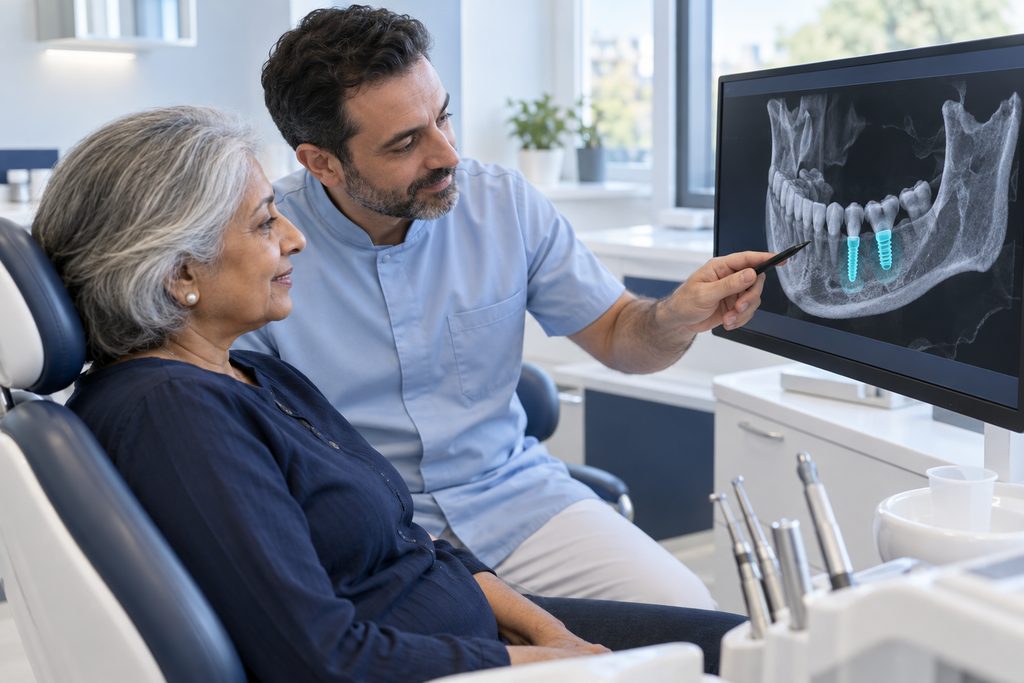
You should know the name of the dentist who will treat you before you book, and be able to speak to them. Coordinators do valuable work on travel and appointments, but they are not dentists and should not decide your treatment.
Some clinics and agencies keep every conversation with a coordinator, price a full mouth from photos alone and introduce the dentist on the first morning. That puts the sale before the diagnosis.
A safer pattern looks like this: a dentist reviews your X-ray, the plan carries their name and you can book a video call with them. On the day, the same dentist, or a named colleague, treats you.
What should you ask a Turkish dentist before you book?
Copy these into an email. A well-run clinic answers all ten in writing, usually within a day or two.
What should you do next?
Start by shortlisting two or three clinics and sending each one the same questions, so you can compare the answers side by side.
- Send the ten questions above to every clinic on your shortlist, and note how specifically each one replies.
- Check one name properly with the regional dental chamber, using the full name and membership number.
- Read up on your treatment: our guide to dental implants in Turkey covers the trips, the components and what a fair plan includes.
- Understand the wider risks with our dentist’s risk check.
- Ask for a free plan with a named dentist. Send us a photo or an X-ray and a specialist replies within 24 hours.

Frequently asked questions
Yes. Every dentist practising in Turkey needs a five-year dental degree registered with the Ministry of Health, the same length of training as in the UK. Standards still vary between clinics, so check the individual dentist and clinic.
DUS is the national entrance exam for dental specialty training, run by ÖSYM. Dentists who pass it train for three to four years in one recognised field before they can use a specialist title.
Ask which recognised specialty they trained in and for a copy of the certificate, then check it matches what the clinic advertises. Academics are often listed on their faculty’s staff pages.
No, implantology is not a recognised specialty in Turkey or in the UK. It is a focus area that a dentist builds through extra training and experience. Ask about implant training and case numbers instead.
Usually not, because the GDC register lists dentists who practise in the UK. A dentist in Turkey is regulated through the Ministry of Health and the regional dental chamber, so check them there instead.
Dentists in private practice must be members of their regional dental chamber, part of the Turkish Dental Association (TDB). Ask for the membership number and contact the chamber to confirm it.
Ask for the licence type and number, the issuing provincial health directorate and the responsible manager’s name, and check the address matches. Clinics treating international patients should also hold a health tourism authorisation.
Only after passing a registration exam, usually the General Dental Council’s Overseas Registration Exam, and registering with the GDC. Turkish degrees are not automatically recognised in the UK or the EU.
Many dentists who treat international patients speak good English. At Dentsway, our coordinators and dentists speak English with patients. A short video call before you book shows whether you can discuss your treatment comfortably.
Sources
- Türk Diş Hekimleri Birliği: the association and its regional dental chambersTurkish Dental Association (TDB)
- Regulation and licensing of private oral and dental health facilitiesRepublic of Türkiye Ministry of Health
- Diş Hekimliğinde Uzmanlık Eğitimi Giriş Sınavı (DUS)ÖSYM, Measuring, Selection and Placement Centre
- Overseas Registration Exam (ORE)General Dental Council (UK)
- Directive 2005/36/EC on the recognition of professional qualificationsEuropean Parliament and Council of the EU (EUR-Lex), 2005
- ITI membership and FellowshipInternational Team for Implantology (ITI)
- HealthTürkiye: official health tourism portalRepublic of Türkiye Ministry of Health / USHAŞ
- EAO membershipEuropean Association for Osseointegration