


How long do veneers last?
Porcelain and E-max veneers typically last 10 to 15 years or more, and long-term studies found more than 9 in 10 still in place after 10 years. Composite veneers are cheaper but typically need major repair or replacement within 4 to 8 years. How long yours last depends less on the material than on bonding, grinding and daily care, which is why our E-max veneers come with a 10-year written warranty.
- E-max / porcelain
- 10–15 years or more
- Composite
- 4–8 years
- Still in place at 10 years
- More than 9 in 10
- Main risk
- Grinding (bruxism)
- Check-ups
- Every 6–12 months
- Replacement, per tooth
- From €220 (UK about £950)
Key takeaways
- Well-bonded ceramic veneers typically last 10 to 15 years or more; composite usually needs work within 4 to 8.
- Grinding is the main threat. If you grind, a night guard is part of the treatment, not an extra.
- Veneers bonded to enamel last longest, so ask how much tooth will be removed.
- Read the warranty conditions before you book. Ours covers the treatment, not flights or the hotel.
How long do veneers last on average?
Porcelain and E-max veneers typically last 10 to 15 years or more. Composite veneers usually need major repair or replacement within 4 to 8 years. These are typical ranges, not expiry dates.
The long-term research on ceramic veneers is reassuring. An Austrian study that followed 318 glass-ceramic veneers for up to 20 years estimated that 93.5% were still in place at 10 years and about 83% at 20 years.1
An Australian study of nearly 500 porcelain veneers bonded mainly to enamel found 96% surviving at 10 years and 91% at 20 years.2
A veneer’s survival rate is the share of veneers still in place and working at a given point, even if some needed a small repair along the way. A 2016 review that pooled 13 studies put it at 89% over a typical follow-up of 9 years, and at 94% for glass-ceramics.3
E-max is a lithium disilicate glass-ceramic: a strong, translucent porcelain made into shells about 0.3 to 0.7 mm thick. Our E-max veneers guide explains the treatment, and the Hollywood smile page covers full-arch makeovers.
- 93.5%glass-ceramic veneersstill in place at 10 years (Beier 2012)
- 91%porcelain veneersstill in place at 20 years (Layton 2012)
- 7.7×higher failure riskin patients who grind (Beier 2012)
- 10 yearswritten warrantyon our E-max veneers, conditions apply
How long do porcelain, E-max and composite veneers last?
Typical ranges from long-term studies and clinical experience. Feldspathic porcelain is the traditional, hand-layered type of porcelain. Survival figures come from the studies cited.1234
| E-max (glass-ceramic)What we use | Feldspathic porcelain | Composite resin | |
|---|---|---|---|
| Typical lifespan | 10–15 years or more | 10–15 years or more | 4–8 years |
| Survival at about 10 years | 94% (pooled studies) | 87–96% | 88% after 2–8 years |
| Enamel removed | About 0.3–0.5 mm | About 0.3–0.5 mm | Often little or none |
| Stain resistance | High, glazed surface | High, glazed surface | Lower, absorbs colour |
| Repair | Small chips smoothed; larger damage needs a new veneer | As for E-max | Easy to repair in one visit |
| Price per tooth | €220–290 at Dentsway; UK about £950 | Varies by lab | Usually lower than ceramic |
Composite is a reasonable budget or short-term choice, especially for small corrections. For a smile you want to keep for a decade or more, glass-ceramic is the more durable option, provided it is bonded to healthy enamel.
Why do some veneers last 20 years and others fail in five?
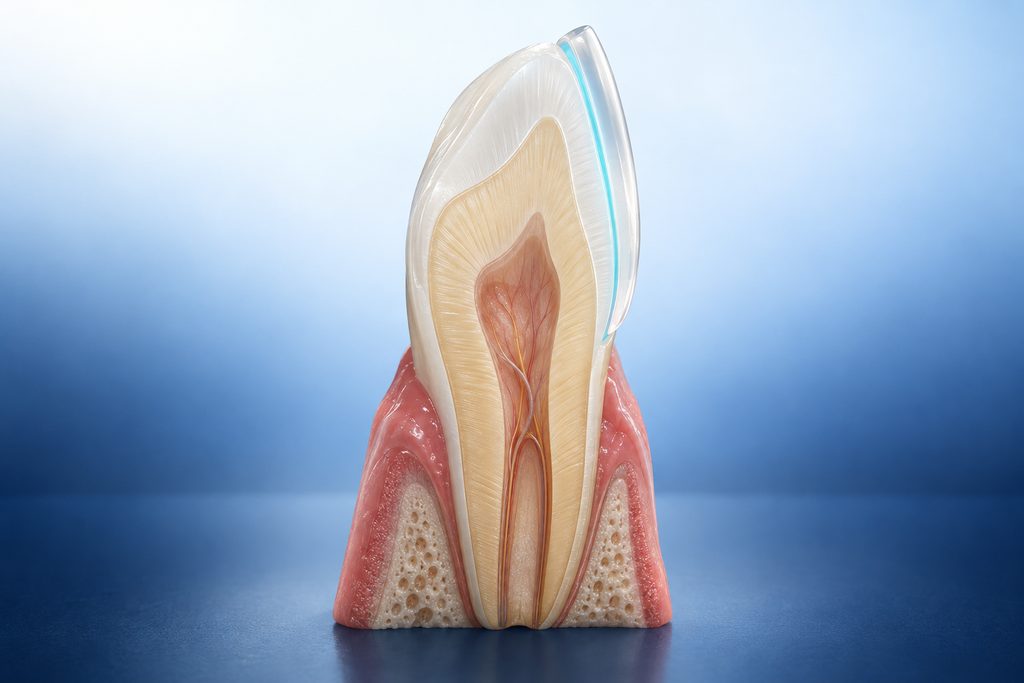
Veneers that last 20 years differ from those that fail early mainly in how they were planned and bonded, not where they were made. A veneer is only as strong as its bond, and that bond is strongest on enamel.
A 2024 review found that ceramic veneers bonded to enamel survived in about 99% of cases, against about 91% when the preparation exposed a lot of the softer dentin underneath.5 That is why a careful dentist removes as little tooth as possible, usually 0.3 to 0.5 mm of enamel, so the bond stays on enamel.
Four other things decide how long veneers last:
- The bite. Veneers designed without checking how your teeth meet take sideways forces they were not made for.
- The fit at the edges. A gap or ledge at the edge (the margin) collects plaque and stain, which leads to decay and sore gums.
- The tooth underneath. Veneers on root-canal-treated teeth failed significantly more often in the 20-year Austrian study.1
- Your habits. Grinding, biting hard objects and skipping check-ups shorten the life of any veneer.
Over-prepared teeth sold as “veneers” are behind many of the Turkey teeth stories. If your plan includes crowns, our guide to veneers vs crowns, tooth by tooth explains how the two differ.
What shortens the life of veneers?
Grinding your teeth is the main threat to veneers, followed by biting hard objects and gum problems.
In the research, fracture or chipping is the most common complication, seen in about 4% of veneers. Coming loose (debonding) affects about 2%, and decay at the edges about 1%.3
- Grinding and clenching. Patients who ground their teeth had a 7.7 times higher risk of failure in the Austrian study.1
- Biting hard things. Ice, hard sweets, pen tops and fingernails. Porcelain copes with even pressure but can chip under a sudden load.
- Contact sport without a mouthguard. A blow to the mouth can crack a veneer or the tooth beneath it.
- Gum disease and recession. As gums shrink back, the veneer edge and the darker root can show. Bleeding when you brush is an early sign worth acting on.7
- Decay at the margin. Porcelain cannot decay, but the tooth at its edge can if plaque is left there.
- Smoking. Smokers in the Austrian study had significantly more staining at the veneer edges.1
Do you need a night guard with veneers?
You need a night guard with veneers if you grind or clench your teeth, and many people do without knowing it. Bruxism is the habit of grinding or clenching the teeth, often during sleep, and over time it can wear, crack or loosen veneers.6
Signs include waking with a tight jaw or a headache, flattened tooth edges, and a partner who hears you grinding.
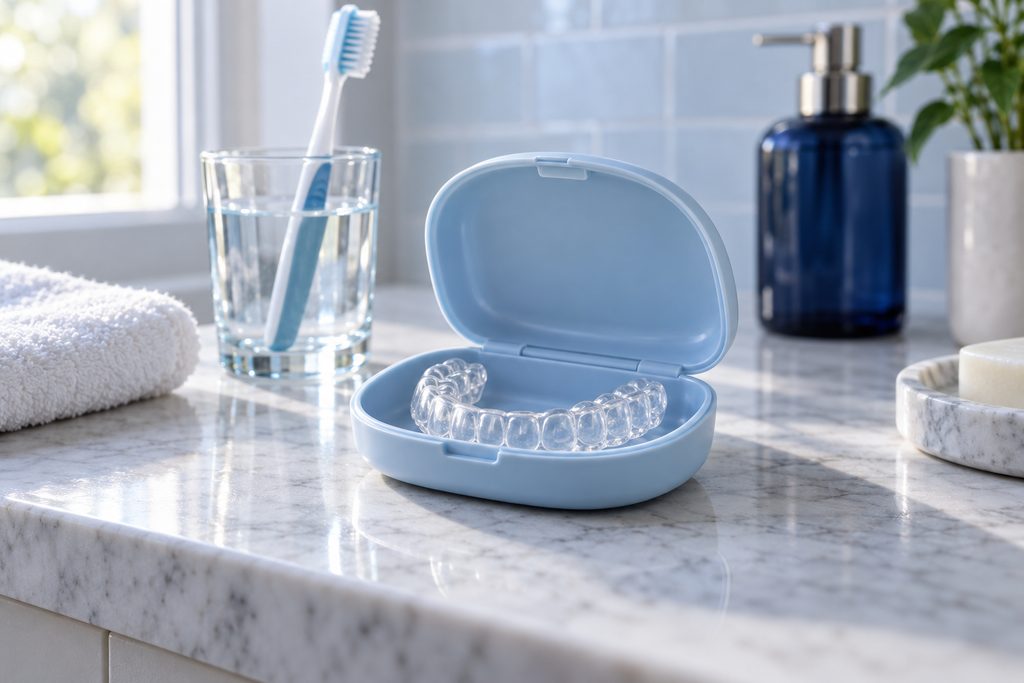
A night guard is a thin, custom-made splint worn over your teeth while you sleep, so the forces go into the guard instead of the porcelain. The NHS recommends the same approach for anyone who grinds.6 It should be made from a scan of your finished veneers, not your old teeth.
At Dentsway, if we see signs of grinding we prescribe a night guard as part of the plan, and wearing it is a condition of the 10-year warranty. Clean it every morning, store it dry in its case and bring it to check-ups.
Can coffee, red wine or whitening toothpaste damage veneers?
Coffee, red wine and other normal food and drink will not damage porcelain or E-max veneers. The glazed ceramic resists staining far better than natural enamel, so coffee, tea and red wine are not a reason to avoid veneers.
There are a few honest caveats:
- The edges can stain. A thin line can appear where the veneer meets the tooth, especially in smokers. A hygienist can often polish it away.
- Composite does stain. Resin absorbs colour over time, one reason composite veneers need refreshing sooner.4
- Veneers do not whiten. Whitening gel lightens natural teeth but not porcelain, so whiten before your veneers are made. Whitening is €180 as an add-on and included in smile makeovers.
- Gritty pastes dull the shine. Abrasive whitening pastes and charcoal powders slowly roughen the glaze.
Hot drinks, flying and electric toothbrushes are all fine.
Most veneers that fail early do not fail because of the porcelain. They fail because of the bite they sit in. If someone grinds, or their teeth meet edge to edge, that has to be planned for first, with a night guard or sometimes with orthodontic treatment, before anyone promises a lifespan.
How do you look after veneers day to day?
Look after veneers as you would natural teeth: brush twice a day, clean between your teeth once a day and see a dentist and hygienist regularly. The Oral Health Foundation notes that veneers can last many years if they are looked after properly.8
- Brush for two minutes, twice a day, with a soft or medium brush and fluoride toothpaste, angling the bristles towards the gum line where the veneer edge sits.
- Clean between your teeth with floss or interdental brushes. If floss catches, slide it out sideways.
- Wear your night guard every night if one was prescribed.
- Wear a sports mouthguard for rugby, hockey, boxing, martial arts and similar sports.
- Use tools, not teeth, for packets, tags and bottle tops.
What does a ten-year veneer maintenance plan look like?
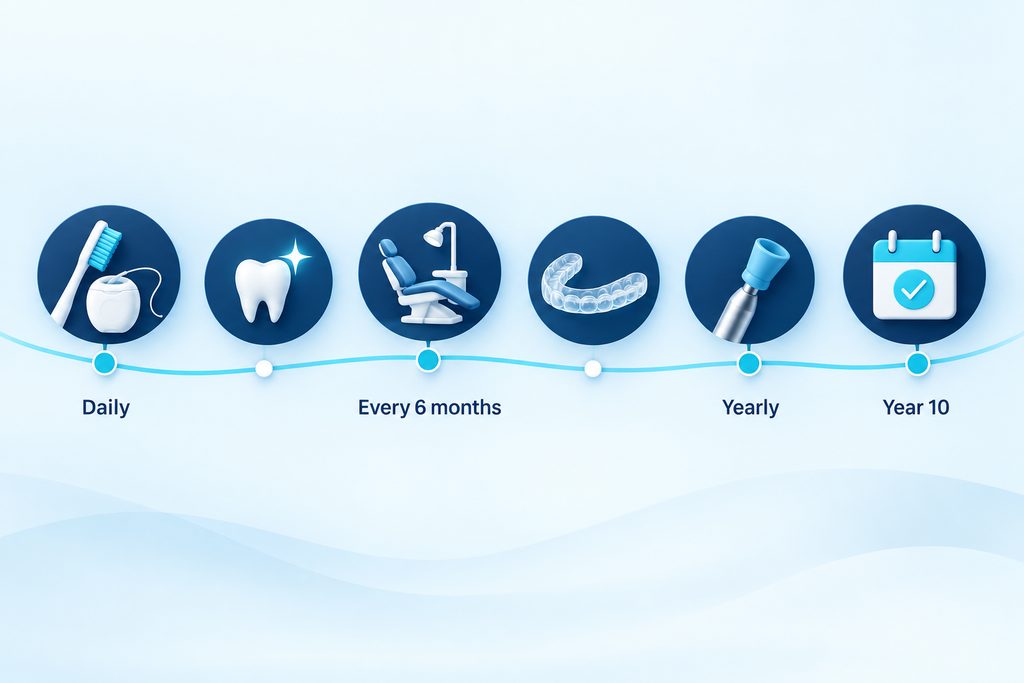
This is the plan we give veneer patients. Your own dentist at home can do the check-ups; send us the notes so your records stay up to date.
- Fitting trip
Veneers fitted, bite checked
Final bonding, a careful bite check, and a night guard made from scans of the new teeth if you grind.
- Month 1
First review
A video call or local visit to check the bite, gums and any rough edges once everything has settled.
- Every 6–12 months
Check-up and hygiene clean
Gums, veneer edges and bite are checked and the veneers polished with a non-abrasive paste. X-rays as your dentist advises.
- Years 2–5
Replace a worn night guard
Guards thin and crack with use. Replace yours when it no longer fits snugly or shows holes.
- Years 5–9
Small touch-ups
Re-polishing stained edges or smoothing a tiny chip. Most of this is quick and needs no trip.
- Year 10
Ten-year review
A full assessment of each veneer and the gums. Healthy veneers carry on; only failing ones are replaced.
What happens at a veneer check-up?
A veneer check-up is a normal dental examination with extra attention to the edges, the gums and your bite. It takes about 30 to 45 minutes with the clean, and any general dentist can do it.
- Each veneer edge is checked for gaps, staining or decay, with X-rays when needed.
- The gums are checked for inflammation or recession.
- Your bite is checked for new high spots or signs of grinding, and your night guard for fit and wear.
- The hygienist removes plaque and tartar and polishes the veneers. Mention them at the start so a suitable paste and instruments are used.
If you had veneers abroad, ask the clinic for the material, shade and cement in writing before you fly home, and take them to your local dentist.

How do you know a veneer needs repair or replacement?
A veneer needs attention if it moves, cracks, chips, darkens at the edge or feels different when you bite. Most problems give early warning, so act early.
- Movement or a clicking feeling. A partly loose veneer can trap bacteria underneath. See a dentist within a few days.
- A chip or a crack. Small chips can often be smoothed; a crack across the veneer usually means a remake.
- A dark line at the edge. Often surface stain that polishes away, but it can also be decay or a leaking margin.
- Gum recession. If the gum shrinks back from the edge, the look changes even though the veneer is sound.
- New sensitivity or a dull ache. This can mean decay or an irritated nerve in the tooth underneath.
A quick monthly look in a mirror, in good light, helps you spot these early.

Can a chipped veneer be repaired, or must it be replaced?
Small chips in porcelain can usually be smoothed or patched with composite, but a cracked or badly chipped porcelain veneer is normally replaced. Composite veneers are easier to repair: the dentist roughens the surface and bonds fresh resin in one visit.
A composite patch on porcelain is a sensible holding measure, but the join can stain and rarely lasts as long as the original.
Replacing a veneer usually takes two appointments a few days apart: the old veneer is removed, the tooth is checked and a new one is made to match its neighbours. Each replacement removes a little more tooth, another reason to protect the first set.
Sometimes the tooth itself has changed. If it has since had a root canal treatment or a large filling, a crown may be the stronger option. A zirconia crown is from €190 at Dentsway, against about £520 privately in the UK.
How much does it cost to replace veneers?
Replacing a veneer costs about the same as a new one. An E-max veneer at Dentsway is €220–290 per tooth, against about £950 at a typical UK private practice in 2026. Under a valid warranty, the treatment to remake a failed veneer is covered, but not flights or the hotel.
For a full set, package prices apply: €3,840 for 16 veneers (UK about £15,200), €4,800 for 20 (UK about £18,000) and €5,760 for 24 (UK about £21,600). Plans over €2,000 include the hotel and airport transfers. Our Hollywood smile cost comparison breaks these down by country.
With one or two veneers, the cost calculation is different. A single veneer is rarely worth a flight on cost alone, and a local dentist can often repair a small chip for less. Travel makes sense when several veneers need replacing, or when the remake is under warranty.
If you start young, expect to replace the set at least once in your life. For the wider picture, see our honest guide to dental treatment in Turkey.
What does a 10-year veneer warranty cover?
A 10-year veneer warranty covers a veneer that breaks, chips badly or comes loose under normal use, and pays for the treatment to remake it. Ours covers the treatment only, not flights or the hotel. To keep it valid, wear your night guard if one was prescribed. Regular check-ups are recommended.
Typically not covered: falls, sport without a mouthguard, biting pens or bottle tops, decay or gum disease left untreated, and wanting a different shade later.
Before you book anywhere, ask in writing what exactly is covered. Ask whether flights and the hotel are included for a remake, and who will see you at home if something goes wrong.
What should you do next?
Focus on what makes veneers last: a conservative plan, healthy gums and a checked bite.
- Get your gums and bite checked first. Untreated gum disease or heavy grinding should be dealt with before veneers.
- Ask how much tooth will be removed, per tooth, and whether the bond will be on enamel.
- Read the warranty conditions and ask whether travel is covered for remakes.
- Compare materials and prices in our E-max veneers treatment guide.
- Send a photo for a free plan. Request your free veneer plan and a prosthodontist replies within 24 hours with a tooth-by-tooth plan and a fixed price.
Frequently asked questions
Typically 10 to 15 years or more, and often longer with good care. Long-term studies found more than 9 in 10 porcelain veneers still in place after 10 years. Grinding, gum disease and biting hard objects are the main reasons they fail sooner.
Typically 4 to 8 years before they need major repair or replacement. Composite is softer than porcelain, so it wears, chips and stains more easily, but it is cheaper and simple to repair in one visit.
The treatment is permanent, but the veneers themselves are not. Most porcelain veneers need a thin layer of enamel removed, usually 0.3 to 0.5 mm. That tooth will then always need a veneer or crown, and each one will eventually need replacing.
Small chips can often be smoothed or patched with composite in one appointment. A cracked or badly chipped porcelain veneer is usually replaced, while composite veneers can be repaired by adding fresh resin.
Porcelain and E-max veneers resist staining very well, so coffee, tea and red wine are fine. The edges can pick up a thin stain line, especially in smokers, which a hygienist can usually polish away. Composite veneers stain more easily.
You need one if you grind or clench your teeth, which many people do in their sleep. Grinding was linked to a 7.7 times higher risk of veneer failure in a 20-year study, and a custom night guard takes that force instead.
They stay alive and healthy if you keep them clean. The veneer cannot decay, but the tooth at its edge can, so brushing along the gum line, cleaning between teeth and regular check-ups matter.
It can be, as long as the clinic offers a written warranty and your notes go to your local dentist. Small repairs can usually be done at home, and a full replacement abroad still costs a fraction of UK private fees.
Sources
- Clinical performance of porcelain laminate veneers for up to 20 years (Beier US et al., Int J Prosthodont 25(1):79–85)The International Journal of Prosthodontics, via PubMed, 2012
- The up to 21-year clinical outcome and survival of feldspathic porcelain veneers: accounting for clustering (Layton DM, Walton TR, Int J Prosthodont 25(6):604–612)The International Journal of Prosthodontics, via PubMed, 2012
- Main clinical outcomes of feldspathic porcelain and glass-ceramic laminate veneers: a systematic review and meta-analysis of survival and complication rates (Morimoto S et al.)The International Journal of Prosthodontics, 2016
- Survival and complication rates of resin composite laminate veneers: a systematic review and meta-analysis (Lim TW et al.)Journal of Evidence-Based Dental Practice, 2023
- Clinical survival and complication rate of ceramic veneers bonded to different substrates: a systematic review and meta-analysis (Alqutaibi AY et al.)The Journal of Prosthetic Dentistry, 2024
- Teeth grinding (bruxism)NHS (UK)
- Gum diseaseNHS (UK)
- VeneersOral Health Foundation (UK)