

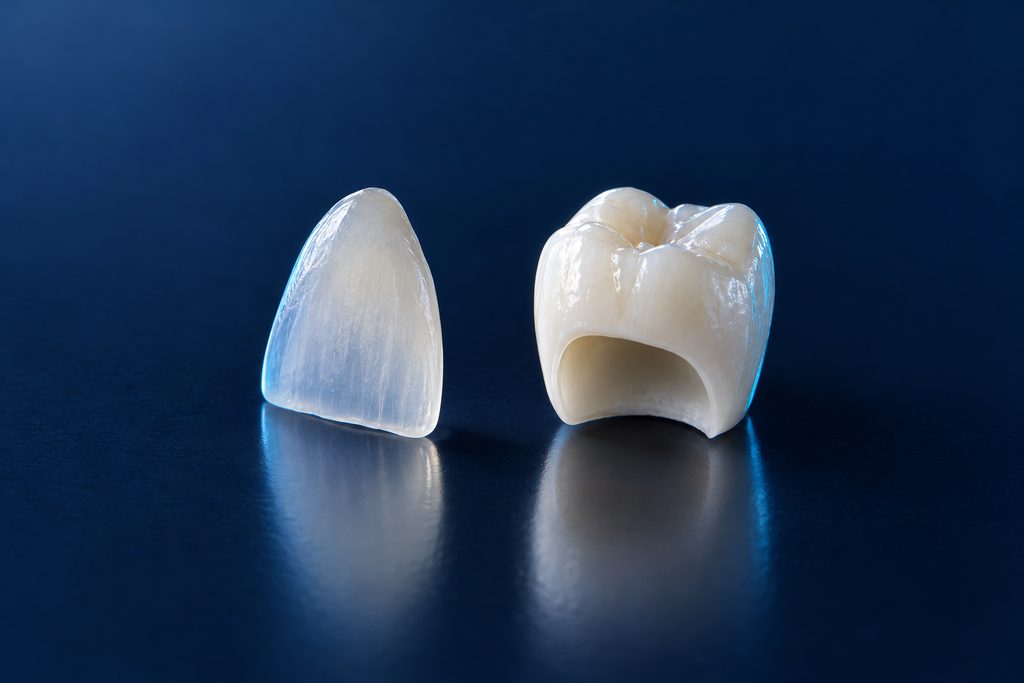
Veneers vs crowns: which do you need for each tooth?
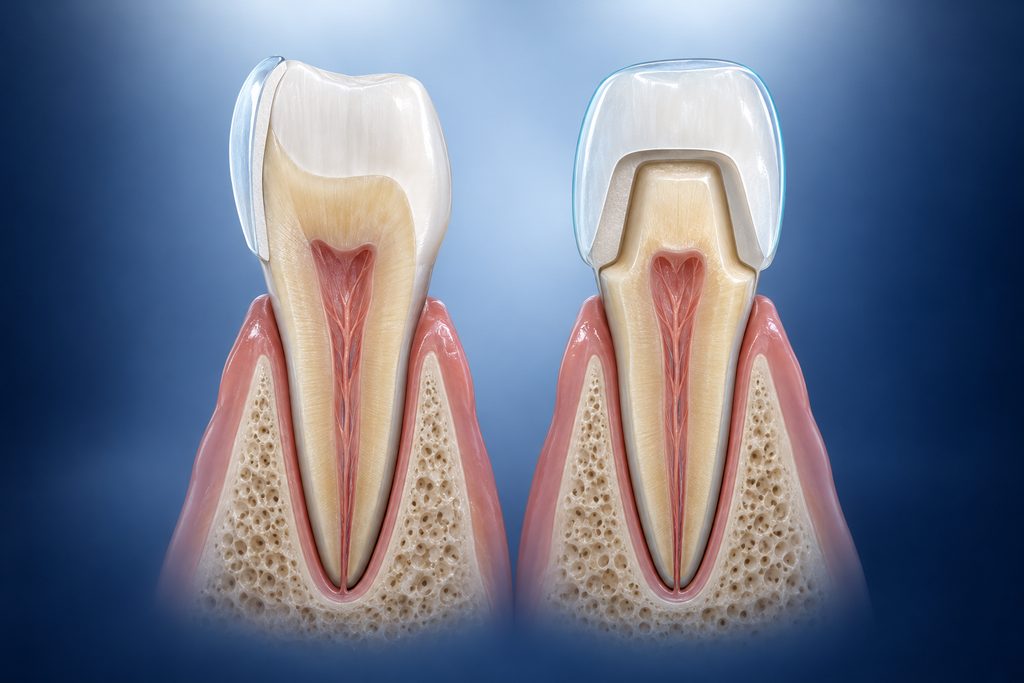
A veneer removes about 0.3–0.5 mm of enamel from the front of a healthy tooth, while a crown needs about 1–1.5 mm trimmed from every side. Veneers suit healthy front teeth that need a new colour, shape or position, and crowns suit teeth already weakened by large fillings, cracks or root canal treatment. Most smiles need a mix, so ask for a tooth-by-tooth plan and compare prices in our E-max veneers guide and zirconia crowns guide.
- Veneer preparation
- 0.3–0.5 mm, front only
- Crown preparation
- 1–1.5 mm, all round
- E-max veneer
- From €220 per tooth
- Zirconia crown
- From €190 per tooth
- Time in Istanbul
- One trip, 3–7 days
- Written warranty
- 10 years on both
Key takeaways
- A veneer keeps most of the tooth; a crown replaces its whole outer layer. Neither can be undone, so decide tooth by tooth.
- Crowns are right for root-filled back teeth, cracked teeth and teeth that are mostly filling.
- Healthy front teeth rarely need crowns. Whitening or aligners may do part of the job.
- A lower price per tooth is never a reason to choose a crown. Ask for the reason for each tooth in writing.
What is the difference between veneers and crowns?
The main difference between veneers and crowns is how much of the tooth they cover. A veneer is a thin shell of ceramic or composite bonded to the front surface of a tooth to change its colour, shape or length. A crown is a cap that covers the whole visible tooth to restore its strength as well as its look.
Put simply, a veneer is a cosmetic change to a tooth that is basically sound. A crown is a repair for a tooth that has lost much of its structure to decay, large fillings, a crack or root canal treatment.
Both are made and fitted in one trip to Istanbul. Crowns take about 3 to 5 days and veneers 5 to 7 days, so a plan with some of each fits in the same visit. Materials and full price tables are in our E-max veneers guide and our zirconia crowns guide.
- 0.3–0.5 mmveneer preparationfront surface only
- 1–1.5 mmcrown preparationon every side
- 3–30%of the tooth above the gumfor a veneer (study)
- 63–72%of the tooth above the gumfor a full crown (study)
How do veneers and crowns compare, side by side?
Typical figures for porcelain veneers and ceramic crowns. Your dentist's measurements for your own teeth come first.
| Porcelain veneer (E-max) | Crown (zirconia or E-max) | |
|---|---|---|
| What it covers | Front surface and biting edge | The whole tooth above the gum |
| Tooth removed | About 0.3–0.5 mm, mostly enamel | About 1–1.5 mm on every side |
| Needs healthy enamel | Yes, it bonds to enamel | No, it can rebuild a weak tooth |
| Suits | Healthy front teeth: colour, shape, small gaps, chips | Root-filled, cracked or heavily filled teeth |
| Strength | Strong once bonded, not for weak teeth | Very strong, especially zirconia |
| Later options | Can be re-veneered or crowned | Can only have another crown |
| Price at Denture | €220–290 per tooth | €190 (zirconia) to €260 (E-max) |
| Typical UK private fee, 2026 | About £950 | About £520 to £700 |
If a tooth is healthy, the default should be the option that removes less of it. A crown is right when the tooth needs protecting, not when it simply needs a new colour.
How much tooth is removed for a veneer compared with a crown?
A veneer usually removes about 0.3 to 0.5 mm of enamel from the front of the tooth, while a crown needs about 1 to 1.5 mm trimmed from every surface.
In a laboratory study of upper front teeth, veneer preparations removed about 3 to 30% of the tooth above the gum, by weight. Full crown preparations removed about 63 to 72%.1
Enamel, the hard outer layer of the tooth, is only about 1 mm thick on front teeth at its thickest. A veneer stays mostly within it, and ceramic bonds very strongly to enamel.
A crown goes through the enamel into the softer dentine. The more is removed, the closer the drill comes to the nerve, and the more the tooth depends on the crown to hold it together.
Neither is reversible, because enamel does not grow back. But a veneered tooth keeps most of its structure and can later be re-veneered or crowned, while a crowned tooth can only ever have another crown.
Some small or inward-set teeth need minimal preparation or none. Ask how much each tooth will lose, in millimetres, before you agree to anything.
When is a crown the right choice?
A crown is the right choice when a tooth has lost so much structure that it needs holding together, not just a new surface.3 These are the situations where I recommend one:
- Large fillings. When more than about half of the visible tooth is filling, there is too little enamel left to bond a veneer to.
- Back teeth after root canal treatment. They are more brittle and take heavy chewing forces. In one long-term study, root-filled teeth that were not crowned were lost about six times as often as those that were.5
- Cracked teeth. A crown wraps the tooth and holds a crack together; a veneer cannot.
- Badly worn teeth. Teeth worn short by grinding or erosion often need full coverage, plus a night guard.
- Replacing an old crown. A crowned tooth cannot go back to a veneer; it gets a new, better-matched crown.
- On an implant. An implant always carries a crown. Our dental implants guide explains how.
Crowns are routine and well proven: in England the NHS provides them under its Band 3 charge when clinically needed.4 The problem is only crowns on teeth that did not need repairing.
For back teeth there is also a middle option. An onlay, or partial crown, covers only the weakened cusps (the raised points of a back tooth) and keeps its healthy sides.
A crown is a repair, not a cosmetic upgrade. As an implant surgeon I see where unnecessary crowns can lead years later: root canal treatment, a fracture, then an implant. If a tooth is healthy, keep as much of it as you can.
Are veneers or crowns better for front teeth?
For healthy front teeth, veneers are usually the better choice, because they change colour, shape and small gaps while keeping most of the tooth. The Oral Health Foundation describes veneers as a way to improve the colour, shape and position of teeth.2
Veneers work well for:
- Teeth that stay discoloured after whitening, including a single darkened tooth.
- Small chips, worn or uneven edges, and teeth that look too short.
- Small gaps and mildly crooked teeth, if you do not want orthodontics first.
- Old, stained composite bonding you want to replace.
Ask first whether something simpler would do part of the job. Whitening alone may fix colour, and clear aligners (see our Invisalign treatment guide) may straighten teeth so that fewer, thinner veneers are needed.
Not every front tooth suits a veneer. One that is root-filled and dark, heavily filled or cracked often does better with a crown, which is why the decision belongs to each tooth, not the whole smile.

Are you a good candidate for veneers rather than crowns?
A quick self-check before your consultation. The final answer comes from X-rays and an examination of each tooth.
A good fit if you have
- Healthy front teeth with no large fillings
- Enough enamel on the front surface, with no deep wear
- Healthy gums and no active decay
- Concerns about colour, shape, small chips or small gaps
- No heavy grinding, or a willingness to wear a night guard
Better options if you have
- A tooth that is mostly filling, or root-filledA crown, or an onlay on a back tooth
- A cracked toothA crown that holds the tooth together
- Only yellowing on otherwise good teethWhitening first, then decide
- Crowded or rotated teethAligners first, then fewer or thinner veneers
- Bleeding gums or untreated decayTreatment with your dentist at home first
Which material: E-max, zirconia or composite?
E-max is the usual material for veneers, zirconia for back-tooth crowns, and E-max or multilayer zirconia for front-tooth crowns, depending on how much strength the tooth needs. Composite is a cheaper, shorter-lived option for veneers.
- E-max (lithium disilicate). A glass-ceramic that can be made very thin and lets light through like enamel. The usual choice for veneers and front-tooth crowns.
- Zirconia. The strongest tooth-coloured material in routine use, for back teeth and heavy biters. It is more opaque, which helps hide a dark root-filled tooth.
- Multilayer aesthetic zirconia. Graded from a strong body to a more translucent edge: a good compromise for front crowns that need extra strength.
- Composite resin. Built up by hand on the tooth, often with little or no drilling. Cheaper and easy to repair, but it stains and chips more readily.
The lab matters as much as the ceramic. A skilled ceramist layers and stains each veneer by hand so it blends with its neighbours.
One practical point: ceramics do not respond to whitening. If you want your natural teeth lighter, whiten them before the shade of your veneers and crowns is chosen.
How much do veneers and crowns cost per tooth?
Our 2026 prices per tooth in Istanbul against typical UK private fees in 2026. Packages and inclusions are on our treatment pages.
| Denture, IstanbulOur 2026 prices | UK private, typical 2026 | |
|---|---|---|
| E-max veneer | €220–290 | About £950 |
| Zirconia crown | €190 | About £520 |
| Multilayer aesthetic zirconia crown (front teeth) | €240 | About £650 |
| E-max crown | €260 | About £700 |
A crown does not cost more just because it covers more tooth. That is why a veneer can cost more than a zirconia crown.
Why can a veneer cost more than a crown?
A veneer can cost more than a crown because it takes more skilled work, not more material. A veneer is thinner, usually layered by hand to copy enamel, and bonded under strict moisture control, one tooth at a time.
That creates an uncomfortable incentive in some clinics: crowns can be quicker to make, yet they remove far more tooth. A lower price should never be the reason a healthy front tooth is crowned.
Our prices per tooth are roughly two thirds lower than typical UK private fees, or more, before flights. On plans over €2,000 the hotel and airport transfers are included.
Pricing a whole smile? A set of 16 veneers is €3,840 at our clinic. Our Hollywood smile cost guide compares full-smile prices by country, and our Hollywood smile page lists what is included.

How long do veneers last compared with crowns?
Well-made porcelain veneers and ceramic crowns typically last 10 to 15 years or more. A systematic review of glass-ceramic and porcelain veneers found close to 9 in 10 still in place after about 10 years.6
A large review of single crowns found more than 9 in 10 survived at least 5 years across the main ceramics, including lithium disilicate and zirconia.7
Composite veneers have a shorter life, typically about 4 to 8 years, although they are easier to repair.
The same things shorten the life of both: grinding without a night guard, biting hard objects, gum disease and decay at the edges. Our veneers and crowns carry a 10-year written warranty, with conditions such as regular check-ups and a night guard where we prescribe one.
Care, warning signs and replacement are covered in our guide to how long veneers last.
How does a prosthodontist decide, tooth by tooth?
A prosthodontist, a dentist who specialises in restoring and replacing teeth, decides by examining every tooth on its own merits and then designing the smile as a whole. Our plans start with X-rays, a 3D scan, photographs and a digital smile design, and every tooth in the smile line is given a reason for what happens to it.
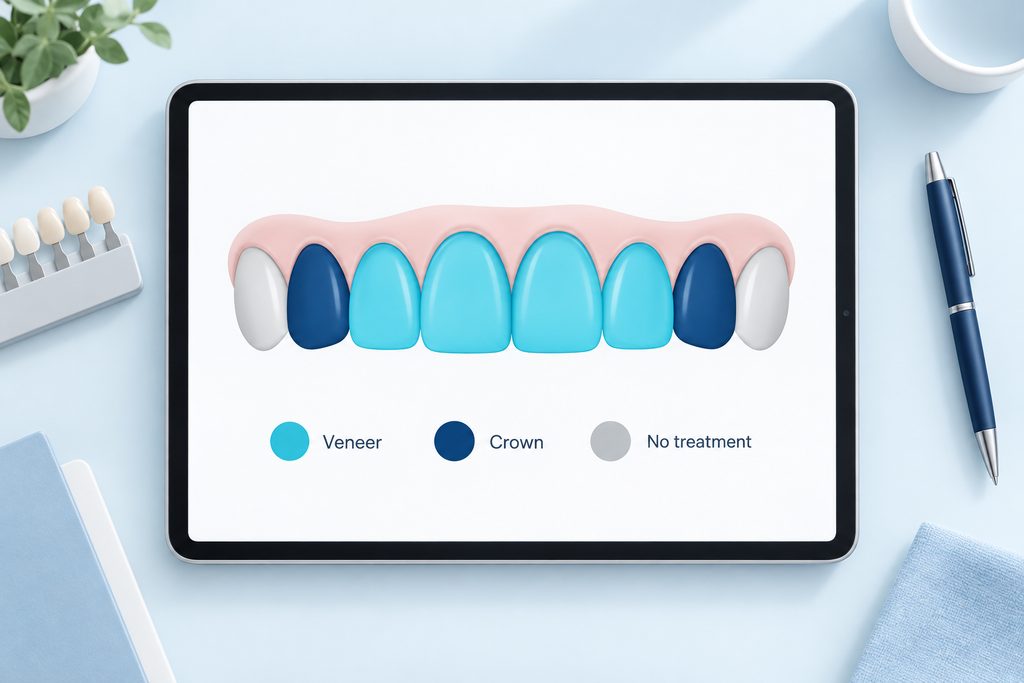
Here is an illustrative mixed plan for the upper front teeth, not a real patient:
- Four front incisors: healthy, slightly yellow, small chips. E-max veneers.
- Both canines: healthy but darker than the incisors. E-max veneers to match.
- Left first premolar: root-filled, with a large filling. A zirconia crown to protect it.
- Right first premolar: an old crown with a dark line at the gum. A new crown, shade-matched to the veneers.
- Second premolars: healthy and barely visible when smiling. Nothing, or whitening.
Six veneers, two crowns and two untouched teeth: that is what a careful plan often looks like. Ten identical crowns on the same mouth would remove several times more healthy tooth for a similar look.
That gap between what a mouth needs and what is sold is the story behind Turkey teeth, and it can happen anywhere. Our honest guide to dental treatment in Turkey covers how to choose a clinic.
Questions to ask before you agree to veneers or crowns
Take this list to any consultation, with us or anywhere else. A good dentist will answer each one in writing.
What should you do next?
Start with a plan for each tooth, not a price for a smile. These steps take a few minutes and cost nothing.
- Fix the basics first. If you have bleeding gums, decay or pain, see your local dentist before any cosmetic work.
- Take three daylight photos: a full smile, a close-up of your front teeth, and your teeth slightly apart. Add any recent X-ray.
- Ask for a tooth-by-tooth plan through our free plan form. A prosthodontist replies within 24 hours with a recommendation and a fixed price for every tooth.
- Compare like with like. Our E-max veneers guide and zirconia crowns guide have full price tables; check any quote against the questions above.
- Plan your aftercare. Keep a check-up with your dentist at home and ask whether you need a night guard.
Frequently asked questions
Neither is better in general; each suits a different tooth. Veneers suit healthy front teeth because they remove much less tooth. Crowns suit teeth weakened by large fillings, cracks or root canal treatment.
Not always. At Denture an E-max veneer costs €220–290 per tooth and a zirconia crown €190 per tooth, because veneers take more hand layering and a longer bonding appointment. Price should never decide which one a tooth gets.
Usually about 0.3 to 0.5 mm of enamel from the front surface only, and sometimes none on small or inward-set teeth. A crown needs about 1 to 1.5 mm removed from every side of the tooth.
No. A veneer needs natural enamel to bond to, and a crowned tooth has none left on the outside. An old crown that no longer matches is replaced with a new crown.
Sometimes, on a front tooth with plenty of its own structure that is not too dark. Root-filled back teeth almost always need a crown or an onlay, because they are more brittle.
Yes. If a veneered tooth later breaks or needs a root canal, it can be crowned. The reverse is not possible, which is a good reason to start with the more conservative option.
Both can look natural when well designed and well made. E-max veneers are often more lifelike on front teeth because they are thin and translucent like enamel.
A crown removes a lot of tooth for good, but on a tooth that needs it, a crown protects what is left. The harm comes when healthy teeth are crowned for purely cosmetic reasons.
Yes, and it is very common. Veneers and crowns can be made by the same lab and shade-matched together, so they look like one set of teeth. A mixed plan is usually finished in one trip of 5 to 7 days.
Sources
- Tooth structure removal associated with various preparation designs for anterior teeth (Edelhoff D, Sorensen JA)Journal of Prosthetic Dentistry, 2002
- VeneersOral Health Foundation (UK)
- CrownsOral Health Foundation (UK)
- How much NHS dental treatment costsNHS (UK)
- Relationship between crown placement and the survival of endodontically treated teeth (Aquilino SA, Caplan DJ)Journal of Prosthetic Dentistry, 2002
- Main clinical outcomes of feldspathic porcelain and glass-ceramic laminate veneers: a systematic review and meta-analysis of survival and complication rates (Morimoto S et al.)International Journal of Prosthodontics, 2016
- All-ceramic or metal-ceramic tooth-supported fixed dental prostheses? A systematic review of the survival and complication rates. Part I: single crowns (Sailer I et al.)Dental Materials, 2015